

Last Updated: November 17, 2026
Quick Summary
An ac unit leaking water inside your house is almost always a drainage problem, not a cooling problem. Your AC pulls moisture from the air, and when the drain line clogs, the pan cracks, or the coil freezes, that water ends up on your floor instead. Most causes are simple to find, and some you can fix yourself in under an hour.
- A clogged condensate drain line is the number one cause we find, and clearing it is a 20-minute job.
- Turn the thermostat to Off, not just to a higher temperature, to stop condensation at the source.
- Never pour chemical drain cleaner into a condensate line because it can crack plastic pans and damage the coil.
- Shut the breaker off and call a pro if you see water touching electrical parts.
- Call a professional when the coil freezes again after thawing or the pan is cracked or rusted through.
Table of Contents
- Why Is My AC Unit Leaking Water Inside My House?
- How to Identify Where the Water Is Coming From
- The Most Common Causes of an AC Water Leak
- How to Fix Water Leaking From an AC Indoor Unit
- Is Water Dripping From an AC Dangerous?
- AC Leak Repair Cost and When to Call a Professional
- Book an AC Leak Inspection With 1st Service HVAC
- Frequently Asked Questions
Why Is My AC Unit Leaking Water Inside My House?
A puddle under your air handler usually means one thing: condensation is going where it shouldn’t. Your AC unit leaking water inside the house is almost always a drainage problem, not a cooling problem. This is one of the most common calls during summer. The good news? Most causes are simple to find, and some you can fix yourself in under an hour.
Here’s the short answer: your AC pulls moisture out of the air, and that water has to leave through a drain line. When the line clogs, the pan cracks, or the coil freezes, water ends up on your floor instead.
Below, we’ll show you exactly how to trace the leak to its source, fix the common ones, and know when to stop and call a pro.
How Condensation Turns Into an Indoor Leak
Condensation is the moisture your AC pulls from warm indoor air as that air passes over the cold evaporator coil. A typical home’s system removes several gallons of water a day in humid weather.
That water drips into a drain pan. From there it flows out through a condensate drain line, usually a PVC pipe that runs to a floor drain or outside.
When any part of that path fails, water backs up. It pools in the pan, overflows, and lands on your floor, ceiling, or ductwork.
The U.S. Department of Energy’s guide to air conditioning explains that dehumidifying is a core job of your system, not a side effect. That’s why the leak rarely stops on its own.
How to Identify Where the Water Is Coming From
Before you diagnose anything, protect the house. Water and electricity are a bad pair, and the air handler closet usually holds both.
Step 1: Stop the water at the source. Set the thermostat to Off, not just to a higher temperature. If the unit keeps running, cooling continues and so does the condensation. If you see standing water within a foot of the unit’s electrical panel, the circuit board, or the blower motor, switch off the dedicated breaker for the air handler at your panel before you touch anything. If you can’t tell which breaker it is, leave the power on and keep your hands and tools out of the cabinet.
Step 2: Contain the water. Lay down towels or a shallow pan, and move cardboard boxes, rugs, and stored items off the wet floor. Water under an air handler wicks into drywall, baseboards, and subfloor within hours. A wet-vac used on a dry setting pulls up standing water faster than towels and reduces the humidity load in the closet.
Step 3: Trace the leak by location and system behavior. Use this decision path instead of guessing:
- Water at the base of the indoor unit, system still cooling, no ice visible: almost always a clogged condensate drain line or a drain pan that has cracked or rusted through. Go to the drain-line check below.
- Water at the base, system running but airflow from the vents feels weak or warm: suspect a frozen evaporator coil that is now melting. Look for frost on the larger copper suction line and on the coil cabinet before you do anything else.
- Water on the ceiling or in the attic decking below the unit: the pan has overflowed, which points to a blocked drain, a failed condensate pump, or a float switch that didn’t trip. Shut the system off and do not climb into the attic on wet joists.
- Water appears only on hot, humid days and clears when the weather dries out: normal condensation volume is overwhelming a slow drain. The line isn’t fully blocked, but it’s restricted.
- Water near the unit with the pump silent during active cooling: a condensate pump that isn’t running, or a pump float stuck closed. Confirm the pump has power at its outlet before assuming the pump is dead.
Step 4: Confirm the source before you repair. Dry the area completely, restart the system, and watch for 20 to 30 minutes. Water that reappears at the unit base while the coil stays ice-free confirms a drain problem. Water that appears only after the system has run a long time, with frost forming on the lines, points to airflow or refrigerant trouble instead.
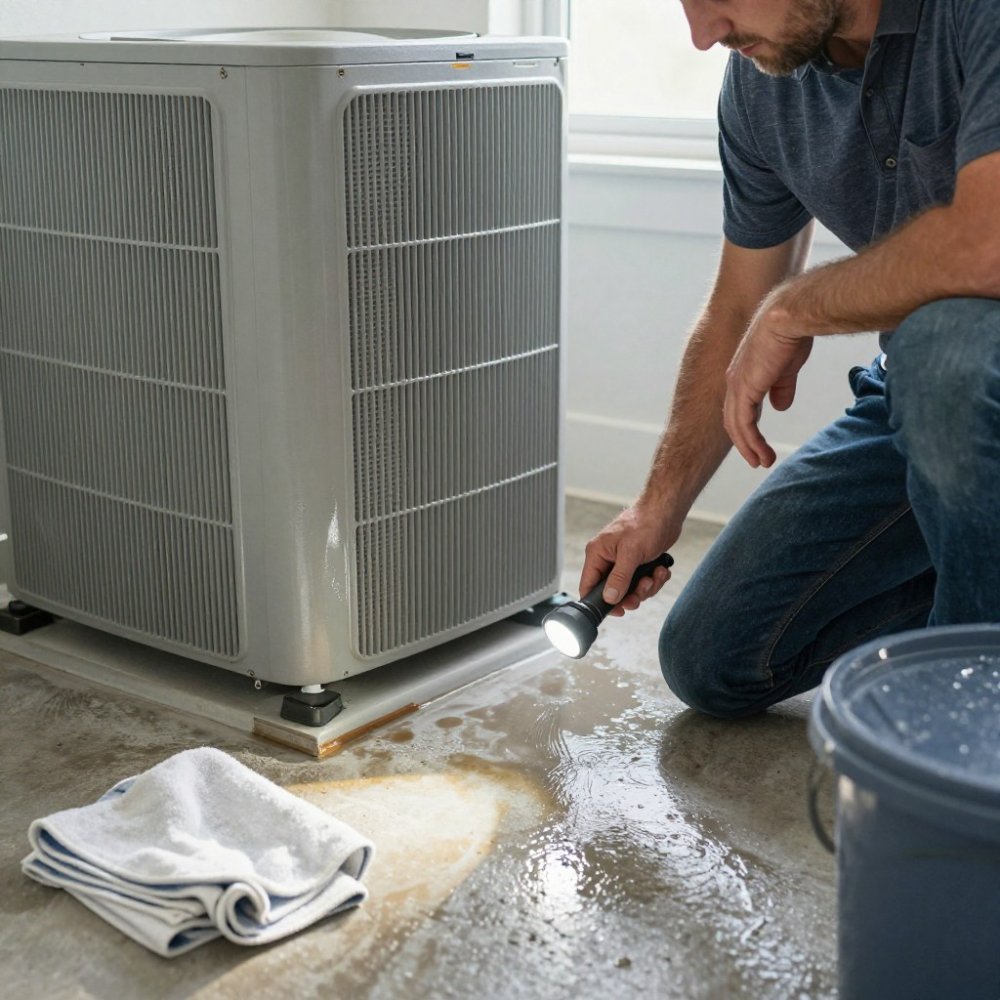
A common pattern is a leak that looks like a pan failure but turns out to be a partially blocked drain backing water up into the pan. Confirm the drain is clear before assuming the pan needs replacing.
The Most Common Causes of an AC Water Leak
Most indoor leaks trace back to one of three failures. Here’s how to tell them apart.
| Cause | Telltale Sign | DIY or Pro |
|---|---|---|
| Clogged drain line | Water at unit base, no ice | DIY |
| Frozen evaporator coil | Ice on lines, weak airflow | DIY thaw, pro check |
| Cracked pan or bad pump | Water under unit, pump silent | Pro |
Clogged Condensate Drain Line
A clogged AC condensate drain line is the number one cause we find. Dust, algae, and debris build up inside the pipe until water can’t pass.
Watch for water pooling at the unit’s base while the system still cools fine. That’s the classic sign. Clearing it is a 20-minute job most homeowners can handle.
Frozen Evaporator Coil and Ice Buildup
A frozen evaporator coil means ice is blocking airflow and cooling. Low refrigerant or a dirty air filter usually causes it. You’ll see frost on the copper lines and water once it melts.
Turn the system off and let the ice thaw completely before restarting. If it freezes again, the underlying cause needs a technician. Warm air blowing from your vents often points to the same airflow problem, which our guide on why your AC is blowing warm air walks through step by step.
Cracked Drain Pan or Faulty Condensate Pump
A cracked drain pan or a dead condensate pump lets water escape before it reaches the drain. Pans rust and crack with age. Pumps fail quietly.
If your unit sits in a basement or attic and uses a pump, listen for it running. Silence during active cooling is a red flag.
How to Fix Water Leaking From an AC Indoor Unit
Here’s how to fix water leaking from an AC indoor unit, starting with the easiest fix.
Clearing a Clogged AC Condensate Drain Line
- Turn off the system at the thermostat.
- Find the drain line leaving the indoor unit.
- Look for the access cap or tee on the line.
- Pour a cup of distilled white vinegar into the opening.
- Wait 30 minutes, then flush with water.
- Check the drain pan for standing water.
- Restart and watch for a full hour.
If water still backs up, the clog is deeper and may need a shop vac or a technician’s line flush. Watch out: never pour chemical drain cleaner into a condensate line. It can crack plastic pans and damage the coil.
Is Water Dripping From an AC Dangerous?
Water dripping from an AC is usually not dangerous on its own, but the damage it causes can be. The real risks are slip hazards, stained ceilings, and mold growth in wet insulation.
The bigger safety concern is electrical. Water near the air handler can reach wiring or the circuit board. If you see water touching electrical parts, shut the breaker off and call a pro.
Mold is the slow risk. Damp drywall and insulation grow mold within days. Dry everything thoroughly and replace wet materials.
AC Leak Repair Cost and When to Call a Professional
AC leak repair cost depends on the cause. A drain line flush is typically a quick service call, while a cracked pan or failed pump involves more work because parts must be removed. Pricing varies by job, so contact 1st Service HVAC for a current quote before any work starts.
Call a professional when:
- The coil freezes again after thawing.
- Water touches electrical components.
- The pan is cracked or rusted through.
- You smell musty odors near the unit.
- The leak returns within days.
If you’re weighing after-hours help, our guide on whether emergency HVAC service is worth the extra cost breaks down the tradeoffs. And before you pay for any repair, it helps to know why HVAC repairs fail quickly so you don’t pay twice. Serious compressor symptoms are worth catching early too, which our article on signs of a failing AC compressor covers.
Book an AC Leak Inspection With 1st Service HVAC
A small leak today can mean a soaked ceiling and mold tomorrow. Don’t wait for the puddle to grow.
1st Service HVAC is a family-owned team serving homeowners in Richmond and the surrounding counties. Our licensed technicians focus on honest, high-quality workmanship. We offer reliable repair for all makes and models and fast response times.
Get started with 1st Service HVAC and stop the leak before it damages your home.
A leaking AC is one of those problems that looks worse the longer you ignore it. Give us a call and we’ll trace the source, explain your options, and fix it right the first time.
Frequently Asked Questions
Can I still run my AC if it’s leaking water?
Turn it off at the thermostat until you find the cause. Running an AC unit leaking water can worsen a frozen coil, overflow the drain pan, and spread moisture into drywall, insulation, and flooring. Shut off the unit, mop up standing water, and check the air filter and drain line. If the leak continues after basic checks, call a licensed technician before restarting the system.
How can I tell if my AC drain line is clogged?
Look for water pooling near the indoor unit, a drain pan that is full, or moisture around the drain pipe. You may also see algae or slime at the drain opening. Some systems have a float switch that shuts the unit off when the line backs up. If you can access the drain line safely, a wet/dry vacuum at the outdoor end can sometimes clear the clog. Persistent backups point to a clogged AC condensate drain line that needs professional clearing.
How much does AC leak repair cost?
AC leak repair cost depends on the cause. Each repair depends on the specific cause, such as a drain line flush, a cracked drain pan, a failed condensate pump, or a low refrigerant issue. Pricing varies by system and location, so ask for a written estimate before work begins. 1st Service HVAC can inspect the leak and explain your options before any repair.
