
Table of Contents
- Why HVAC Repairs Fail Quickly: The Hidden Causes
- Why Your HVAC Keeps Breaking Down After Service
- Signs of a Bad HVAC System You Should Not Ignore
- HVAC Repair vs Replacement: Making the Right Call
- How to Prevent HVAC Breakdowns With Smart Maintenance
- Troubleshooting Checklist: Verify the Repair Was Done Right
- Frequently Asked Questions
Last Updated: October 9, 2026
Why HVAC Repairs Fail Quickly: The Hidden Causes
When an air conditioner breaks down twice in one summer, most homeowners blame the equipment. The real problem is usually the repair itself: a fix that only treats the symptom will always come back. This guide from 1st Service HVAC breaks down the common causes behind repeat breakdowns, so you can spot a patch job before it costs you again.
HVAC repairs fail quickly when the technician addresses the visible symptom instead of the root cause. A weak capacitor gets swapped, but the failing motor that overloaded it stays in place, so the system quits again within weeks.
That pattern is common: a temporary fix feels like progress until the next heat wave, and the second service call often costs more than the first.
A proper diagnosis takes longer than a parts swap, but it lasts. Below, we explain each cause and how to tell the difference before you pay.
Why Your HVAC Keeps Breaking Down After Service
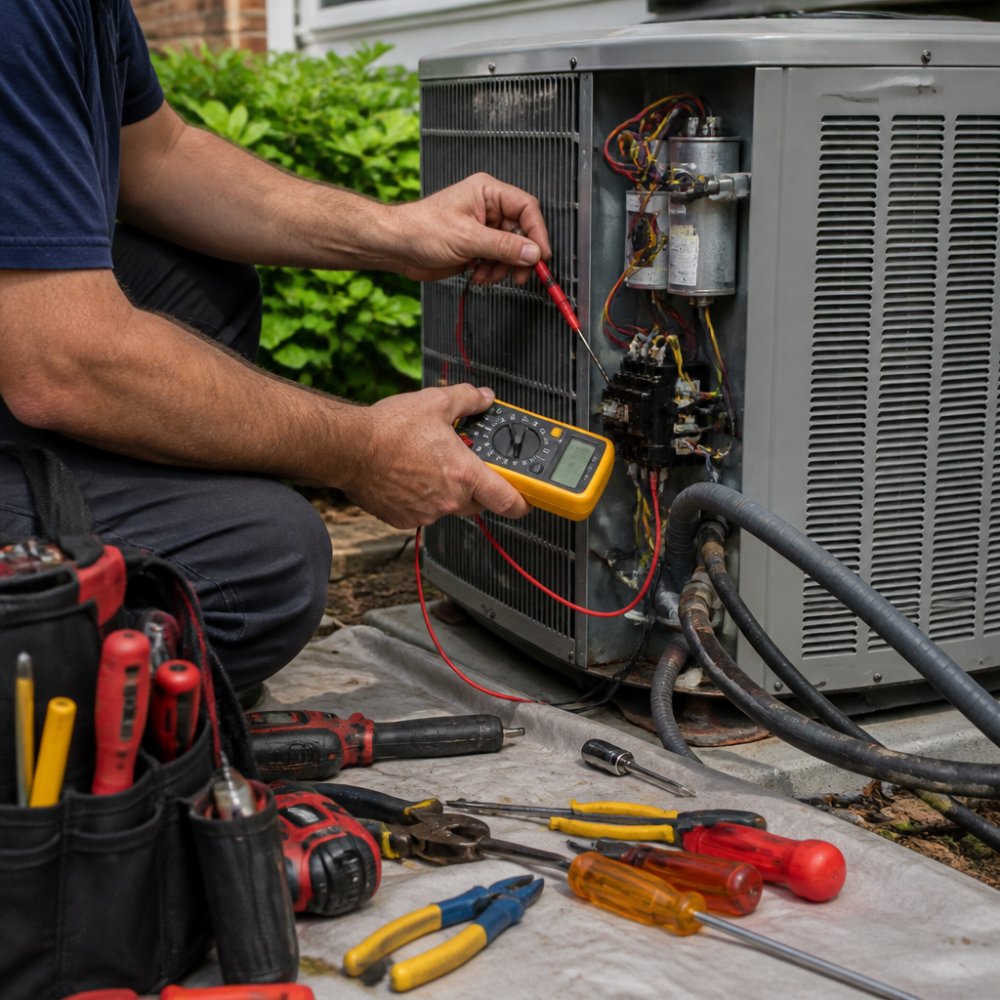
An HVAC system that keeps breaking down after service is usually the victim of a repair that treated a symptom, not a cause.
A repair swaps a part; a fix restores the conditions the part needs to survive. Here are the mechanisms that make a completed repair fail again, roughly in the order we see them.
1. Symptom-only diagnosis. A weak capacitor gets replaced, but the failing motor that drew too much current and cooked it stays in place, so the new capacitor runs hot from day one.
2. No leak test before adding refrigerant. Low refrigerant is a symptom; the cause is a leak, at a Schrader valve, a flare fitting, a brazed joint, or an evaporator coil.
3. Wrong or mismatched parts. Capacitors are rated in microfarads and volts; a close-but-not-correct rating changes how the motor starts and runs. Motors are rated by horsepower, speed, and rotation.
4. Airflow never restored. A clogged filter or dirty evaporator coil restricts airflow, which raises the temperature of the refrigerant returning to the compressor.
5. Electrical connections left loose. A loose terminal at the contactor, capacitor, or compressor plug creates resistance, and resistance creates heat.
**6.
7. System-level problems no single part can fix. An oversized system cools too fast and never removes humidity, so it short cycles. An undersized system runs continuously and never catches up.
**8.
A common mistake is accepting a repair without asking what caused the part to fail. If the answer is vague, “they just wear out”, the fix probably is too.
Never let a technician add refrigerant without a leak test. Topping off a system with a leak is a temporary fix that guarantees a callback, and it can hide a problem that leads to compressor failure. Ask for the leak search results in writing.
A repair fails quickly when the diagnosis stopped at the failed part. The fix that lasts names the root cause, corrects it, and verifies the system runs within its normal operating range afterward.
Signs of a Bad HVAC System You Should Not Ignore
The clearest signs of a bad HVAC system are repeated breakdowns, rising energy bills, uneven cooling, and strange noises or smells. One warning sign alone may be minor. Two or more together usually point to a system nearing the end of its life.
Watch for these signals:
- Frequent repairs – two or more service calls in a single season
- Weak cold air – the system runs but never cools the house
- Short cycling – it turns on and off every few minutes
- Rising utility bills – higher costs with no change in use
- Strange sounds – grinding, squealing, or banging
- Musty odors – often a sign of mold or a clogged drain
Many homeowners wait until total failure, which costs more: a system under strain runs longer, uses more energy, and wears out faster. Catching the warning signs early gives you time to plan instead of paying for an emergency call.
The U.S. Department of Energy guidance on home cooling notes that proper maintenance helps a system run more efficiently and last longer. That is not sales talk. A well-kept system simply has less strain on its parts.
If you are seeing several of these signs at once, it is worth having the system looked at before peak usage arrives.
HVAC Repair vs Replacement: Making the Right Call
The choice between HVAC repair vs replacement comes down to age, repair history, and cost balance. A young system with one failed part is usually worth repairing. An older system with repeat breakdowns often costs less to replace than to keep patching.
Use this framework to decide:
| Situation | Better Choice | Why |
|---|---|---|
| Under 10 years old, first repair | Repair | Plenty of equipment lifespan left |
| Over 15 years old, second repair | Lean replace | Repeat failures signal the end |
| Repair cost nearing half of new unit | Replace | You are funding a dying system |
| Single failed part, rest healthy | Repair | Root cause is isolated |
| Uneven cooling in every room | Replace or major repair | System-wide strain |
The real difference between repair and replacement is not just money but reliability. A system that fails every summer costs you comfort, time, and stress on top of the repair bill.
Reach out to us for more information… →
One honest limitation: replacement is not always the answer. Sometimes a single component is the whole problem. A good technician will tell you which situation you are in, even when the cheaper option is the repair.
Ask for the age of your system and the repair history before you decide. A technician who explains the trade-offs, instead of pushing a sale, is the one worth keeping.
How to Prevent HVAC Breakdowns With Smart Maintenance
You prevent HVAC breakdowns by keeping up with routine maintenance, not by waiting for a failure. Annual servicing catches small issues before they become extensive damage, and most of the steps below take only minutes.
- Replace the air filter every 1-3 months
- Clear debris from around the outdoor unit
- Check the thermostat settings each season
- Keep vents open and unblocked
- Schedule annual servicing before peak usage
- Listen for new noises and act early
- Watch your energy bills for sudden jumps
Preventive maintenance keeps cooling performance steady and extends equipment lifespan, avoiding the strain that leads to component failure.
Many homeowners skip servicing until something breaks. That is backwards. The cheapest repair is the one you never need because a small issue got caught early.
At 1st Service HVAC, we see the same pattern every summer: systems that missed annual servicing fail first when the heat peaks. A tune-up before the season starts beats an emergency call in July.
Troubleshooting Checklist: Verify the Repair Was Done Right
You can verify a repair was done right by asking three questions before the technician leaves: what failed, why it failed, and what proves the system is now operating normally. Clear, specific answers mean the repair is likely solid; vague ones mean you should get a second opinion before you pay.
Most guides stop at “ask questions.” The harder part is knowing what a good answer sounds like and what to do when you do not get one. Use this checklist after any service call.
Before the technician leaves
- The technician named the failed part and showed you the old one
- They explained the root cause, not just the symptom
- They stated the part number and rating of what was installed
- They measured and reported system operating readings, for a cooling call, that typically means suction and liquid line pressures, superheat or subcooling, and temperature split across the evaporator coil
- They confirmed amp draw on the compressor and blower motor is within the nameplate range
- They ran the system through a full cycle and let it stabilize before packing up
- You received a written summary listing parts, labor, and the readings taken
Within the first 24 to 48 hours
- Run the system through at least one full cooling or heating cycle
- Check that the temperature split between the return and the supply registers is in the normal range for your system
- Listen for new noises, grinding, squealing, or banging
- Watch for short cycling (on and off every few minutes)
- Note any new odors, water, or ice on the refrigerant lines
If any of those show up, call the technician back. A repair that fails within days of service is a callback, not a new problem, and a reputable company will treat it that way.
What to ask about the warranty
Parts and labor are usually covered separately, and the terms matter more than the label. Ask:
- How long is the parts warranty, and who honors it, the manufacturer or the contractor?
- How long is the labor warranty, and does it cover the diagnostic visit if the same problem returns?
- Is the warranty void if another company touches the system?
- Does the warranty transfer if you sell the home?
A one-year parts warranty with a 30-day labor warranty is common. A shop that stands behind its diagnosis will usually offer a longer labor window on a repair it is confident in.
When to get a second opinion
A second opinion is worth the diagnostic fee when:
- The same component fails twice in one season
- The technician cannot explain why the part failed
- The recommended repair cost is a large fraction of a new system’s installed cost
- The diagnosis changes between visits
- You are being pushed toward replacement without operating readings to justify it
Ask the second company to measure and document the same readings. Two sets of numbers side by side usually make the right call obvious.
When recurring failures point to replacement
A single failed part on a system with a clean history is a repair. The same failure twice, or failures in different parts within a short window, is a pattern. Patterns usually trace back to a system-level problem, undersized ductwork, a chronically overcharged or undercharged system, an oversized unit, or an installation defect, that no single repair will solve.
What most guides miss is the follow-up. A repair is not finished when the truck pulls away. It is finished when the system has run a full cycle, held its readings, and stayed quiet. If a repair fails again after service, that is a callback, not a new problem. A trustworthy company will honor it.
Keep every invoice, reading sheet, and warranty document in one folder. When a repair fails again, that paper trail is what turns a disagreement into a covered callback.
Frequently Asked Questions
How long should an HVAC repair last?
A properly diagnosed and completed HVAC repair should last for years, not weeks. If a technician replaces a capacitor but never checks why it failed, the new part may burn out again within months. The repair itself is only as good as the diagnosis behind it. Ask your technician what caused the failure and what they did to address the root cause, not just the symptom.
Can a dirty air filter cause repeated HVAC problems?
Yes. A clogged filter restricts airflow, which makes the blower motor work harder and can cause the compressor to overheat. If the filter is not changed, the system may trip its safety switch or shut down repeatedly. Changing your filter every 1-3 months, depending on pets and dust levels, is one of the simplest ways to prevent repeat breakdowns and extend equipment lifespan.
How can I tell if an HVAC technician fixed the root cause?
Ask for a written diagnosis that names the failed component and explains why it failed. A good technician will also show you readings, such as refrigerant pressure, amp draw on the motor, or capacitor microfarad values, before and after the repair. If the explanation is vague or the technician only says ‘it was just old,’ ask a second technician for a diagnosis before authorizing more work.
When should I replace my HVAC system instead of repairing it?
If your system is 12-15 years old and has needed two or more major repairs in the past two years, replacement often makes more financial sense than another repair. Frequent breakdowns, rising utility bills, and uneven cooling are signs of a bad HVAC system that may not be worth fixing again. A licensed technician can compare the cost of the next repair against the remaining lifespan and efficiency of your current unit.