
Table of Contents
- Start With These 5 Checks Before You Call Anyone
- Clogged Air Filters and AC Air Filter Replacement Frequency
- Refrigerant Leaks, Frozen Coils, and a Failing Compressor
- Thermostat Settings, Tripped Breakers, and Blocked Condenser Units
- Heat Pump vs. Central AC: Why the Fix Is Different
- When to Call an HVAC Professional (and What to Do First)
- Your HVAC System Maintenance Checklist for Every Season
- Frequently Asked Questions
Last Updated: September 18, 2026
Start With These 5 Checks Before You Call Anyone
When you notice your AC blowing warm air, the cause is often something simple you can fix in minutes. Before you call a technician, run these five checks. They cover the most common reasons a system stops cooling.
Here is what to look at, in order:
- Thermostat setting. Make sure it is set to “cool” and the fan is on “auto.” Check that the temperature is set below the current room temperature.
- Air filter. Pull it out and hold it up to a light. If you cannot see through it, that is your problem.
- Circuit breakers. Find your indoor and outdoor unit breakers. Reset any that are tripped.
- Outdoor condenser unit. Clear away leaves, grass, and dirt. Make sure it is running and pulling in air.
- Vents and registers. Check that supply vents are open and not blocked by furniture or rugs.
Clogged Air Filters and AC Air Filter Replacement Frequency
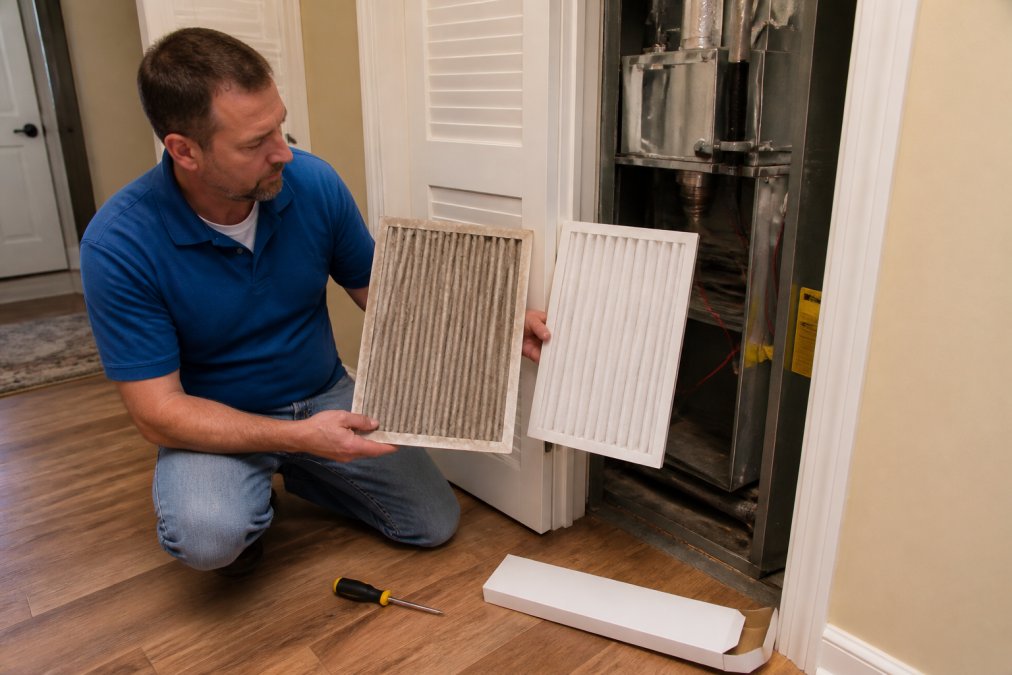
A clogged air filter is the number one cause of an AC blowing warm air. When the filter traps too much dust, air cannot move through the system. The evaporator coil then freezes over, and no cool air reaches your rooms.
How Often to Change Your Filter
Change your filter every 30 to 90 days. The right schedule depends on your home:
- Standard 1-inch filters: every 30 days
- Pleated filters: every 60 to 90 days
- High-efficiency filters: every 90 days
- Homes with pets or allergies: every 30 days
- Homes near dusty roads or new construction: every 30 days
Write the install date on the filter’s cardboard frame with a marker. The next time you check it, you will know exactly how long it has been running.
Refrigerant Leaks, Frozen Coils, and a Failing Compressor
These three problems produce the same symptom, warm air at the vents, but they have different causes, different fixes, and very different safety profiles. Treating them as one issue is how homeowners end up thawing a coil that was never frozen or adding refrigerant to a system that only needed airflow.
Low Refrigerant: A Sealed System Should Never “Use Up” Charge
Refrigerant is not a fuel. It does not get consumed as the system runs. In a sealed system, the charge should last the life of the equipment. If your system is low, refrigerant escaped through a leak, at a Schrader valve, a brazed joint, a coil pinhole, or a line-set fitting.
Signs of low charge:
- Hissing or bubbling near the indoor coil or line set
- Ice on the larger suction line or the outdoor unit
- The compressor runs continuously but the supply air stays warm
- Electric bills climb with no change in thermostat habits
Frozen Evaporator Coil: The Airflow Problem in Disguise
A frozen coil is usually a symptom of restricted airflow, not a refrigerant problem. When a clogged filter, closed register, or failing blower motor chokes off airflow, the coil drops below freezing, and condensation on the fins turns to ice. The ice insulates the coil, so warm air passes over it and reaches your vents.
Thaw sequence:
- Switch the thermostat to “off”, not just “cool.”
- Switch the fan to “on” so the blower moves air across the coil and speeds thawing.
- Check the filter and replace it if it is loaded.
- Wait several hours. Do not chip at the ice, you can puncture the coil.
- Once thawed, run the system and watch the supply air temperature.
Compressor Failure: The Point of No Return
The compressor is the pump that moves refrigerant between the indoor and outdoor coils. When it fails, the outdoor unit may hum without starting, trip its breaker immediately, or run with no cooling at all. A failed compressor is not a homeowner repair. It requires recovery of the refrigerant charge, torch work, and a vacuum before recharge.
What You Can Safely Touch vs. What You Cannot
| Task | Homeowner-safe | Why |
|---|---|---|
| Replace air filter | Yes | No tools, no refrigerant, no electrical exposure |
| Clear debris around condenser | Yes | Power off at the disconnect first |
| Reset a tripped breaker once | Yes | If it trips again, stop |
| Hose off condenser coils | Yes | With power off and fins protected |
| Add refrigerant | No | Requires EPA Section 608 certification and recovery equipment |
| Open the refrigerant circuit | No | Voids most manufacturer warranties and is a federal violation without certification |
| Replace a compressor | No | Requires recovery, brazing, vacuum, and recharge |
Refrigerant released to the atmosphere is regulated under Section 608 of the Clean Air Act. Handling refrigerant without certification is illegal, and venting it is a federal violation. Do not accept a “top-off” from anyone who will not first locate the leak.
If a technician offers to add refrigerant without performing a leak search, ask why. A sealed system that is low has a leak, and the leak will not fix itself.
Thermostat Settings, Tripped Breakers, and Blocked Condenser Units
A thermostat set to “fan only” will run the blower without cooling. This is a common mistake after a power outage or a battery change. Set it to “cool” and confirm the fan is on “auto.”
Never reset a breaker more than once. If it trips again, the system has a real electrical problem. Forcing it back on can damage the compressor or start a fire.
Heat Pump vs. Central AC: Why the Fix Is Different
Most warm-air guides treat every cooling system as if it were a standard central AC. That is a mistake. A heat pump and a central AC share the same basic refrigeration cycle, but a heat pump adds a reversing valve, a defrost control board, and auxiliary heat strips, and any one of those can produce warm air in cooling mode.
How Each System Cools
A central AC has one job: move heat from inside the house to the outdoor condenser. The indoor coil is always the evaporator, and the outdoor coil is always the condenser.
Heat Pump Symptoms That Do Not Apply to Central AC
- Stuck reversing valve. The system runs, the compressor runs, but the air is warm because the valve is stuck in heating position. A firm tap on the valve body sometimes frees it; if not, it is a technician job.
- Defrost cycle confusion. In heating season, a heat pump periodically reverses to melt frost off the outdoor coil. During defrost, the indoor unit may blow cool air for a few minutes. This is normal, not a cooling failure.
- Auxiliary heat strips running in cooling mode. If the thermostat or control board calls for aux heat while the system is set to cool, the strips will warm the supply air. This often traces to a miswired thermostat or a failed outdoor sensor.
- Outdoor thermostat or defrost board fault. A failed sensor can lock the system in the wrong mode.
Central AC Symptoms That Do Not Apply to Heat Pumps
- Compressor failure with no reversing valve involvement. A standard AC has no valve to stick, so warm air almost always traces to charge, airflow, or the compressor itself.
- No defrost cycle. If a central AC ices up, it is an airflow or charge problem, never a normal operating condition.
Diagnostic Order by System Type
| Step | Central AC | Heat Pump |
|---|---|---|
| 1 | Thermostat set to Cool, fan Auto | Thermostat set to Cool, fan Auto, mode confirmed |
| 2 | Air filter and airflow | Air filter and airflow |
| 3 | Outdoor unit running and clear | Outdoor unit running, reversing valve audible on mode change |
| 4 | Supply air temperature split | Supply air split, aux heat not energized |
| 5 | Refrigerant charge and compressor | Refrigerant charge, reversing valve, defrost board |
To confirm your system type, look at the outdoor unit’s data plate. A heat pump will list both a heating and a cooling capacity in BTUs. A central AC lists cooling only. If you are unsure, check the thermostat, heat pumps almost always have an “Emergency Heat” or “Aux Heat” setting.
If you own a heat pump and the air is warm in cooling mode, check the mode setting first, then listen at the outdoor unit when you switch between heat and cool. A healthy reversing valve produces an audible click and a shift in sound. Silence at the moment of the switch points to the valve or its solenoid.
When to Call an HVAC Professional (and What to Do First)
Call a professional when the simple checks do not fix the problem. Refrigerant leaks, compressor failures, and reversing valve issues need licensed hands and special tools.
Before the technician arrives, do this:
- Turn the system off at the thermostat
- Note any strange sounds, smells, or ice buildup
- Write down when the problem started
- Clear a path to the indoor and outdoor units
Your HVAC System Maintenance Checklist for Every Season
A short maintenance routine prevents most warm-air surprises. Use this checklist to keep your HVAC system maintenance on track all year.
| Season | Task | Frequency |
|---|---|---|
| Spring | Replace air filter, clean condenser coils | Monthly |
| Summer | Check refrigerant lines, clear debris around unit | Monthly |
| Fall | Schedule professional tune-up, test heating mode | Once |
| Winter | Keep vents clear, watch for ice on lines | Monthly |
The single best habit for a long-lasting AC is a fresh filter every 30 to 90 days. It costs little and prevents the most common cause of warm air.
Frequently Asked Questions
Should I turn off the AC if it is blowing warm air?
Yes. Turn the system off at the thermostat and switch the fan to auto. Running an AC that is blowing warm air can damage the compressor, especially if the problem is low refrigerant or frozen evaporator coils. Once it is off, check the air filter and the outdoor condenser unit for obvious blockages. If those look fine, leave the system off and call a licensed technician rather than restarting it repeatedly.
Can a dirty air filter cause an AC to blow warm air?
A clogged filter restricts airflow across the evaporator coil. That drops the coil temperature below freezing, ice forms, and the system stops cooling even though the fan keeps running. You feel warm air at the vents because no heat exchange is happening. Check the filter monthly during heavy use and replace it every 1 to 3 months, or more often if you have pets or live in a dusty area.
How do I know if my AC is low on refrigerant?
Warning signs include weak airflow that feels cool at first then turns warm, ice on the copper lines or evaporator coil, and a hissing or bubbling sound near the outdoor unit. Refrigerant does not get used up like fuel; low levels mean a leak. Only a licensed technician can confirm the charge and locate the leak, so do not add refrigerant yourself or top it off without finding the source.
What should I check before calling an HVAC technician?
Run through five quick checks: confirm the thermostat is set to cool and the temperature is below room temperature, replace a dirty air filter, verify the outdoor unit has power and its breaker has not tripped, clear leaves or debris from around the condenser, and make sure the indoor and outdoor units are both running. If the system still blows warm air after these steps, it is time for a professional diagnostic.