
Last Updated: November 8, 2026
Quick Summary
Yes, a heat pump works in cold climates. A cold-climate heat pump moves heat from freezing outdoor air into your home and holds its heating capacity at much lower temperatures than a standard heat pump, so it keeps heating well below freezing. Frost, sizing and backup heat decide how well it performs.
- A heat pump moves heat rather than making it, and freezing air still holds heat energy.
- A cold-climate model has a larger outdoor coil and a variable-speed, cold-rated compressor.
- Frost on the outdoor coil triggers a normal defrost cycle that briefly reverses refrigerant flow.
- Read heating capacity and COP at your design temperature, not the headline minimum operating temperature.
- Electric resistance backup heat runs at a COP of 1.0, so use it sparingly.
Table of Contents
- How a Heat Pump Moves Heat When It’s Freezing Outside
- Cold-Climate Heat Pump vs. Standard Heat Pump: What Actually Differs
- Why a Heat Pump Struggles in Cold Weather (and What Fixes It)
- Minimum Operating Temperature and Capacity: Reading the Real Numbers
- What a Cold-Climate Heat Pump Costs and How to Judge the Price
- Cold-Climate Heat Pump Mini Split: Ductless Options for Older Homes
- Backup Heat, Sizing, and Your Cold-Snap Plan
- Schedule a Cold-Weather Assessment Before the Next Freeze
- Frequently Asked Questions
How a Heat Pump Moves Heat When It’s Freezing Outside
Yes, a heat pump works in cold climates.
A heat pump does not make heat. It moves it. Even freezing air holds heat energy, and a heat pump pulls that heat from outside and carries it indoors.
The U.S. Department of Energy explains the basics of this process in its guide to heat pump systems. The key point: cold air still contains heat, just less of it.
The Refrigerant Loop and Compressor, Explained Simply
Here is the simple version of what happens inside the unit:
- A refrigerant loop carries fluid through an outdoor coil and an indoor coil.
- The outdoor coil absorbs heat from the outside air.
- The compressor raises the refrigerant’s temperature and pressure.
The compressor is the heart of the system.
Cold-Climate Heat Pump vs. Standard Heat Pump: What Actually Differs
A cold-climate heat pump holds its heating capacity at much lower outdoor temperatures than a standard heat pump, and that single difference drives most of the rest.
Standard heat pumps lose heating output as the air gets colder. A cold-climate model is engineered for low-temperature operation.
| Feature | Standard Heat Pump | Cold-Climate Heat Pump |
|---|---|---|
| Heating at mild temps | Strong | Strong |
| Heating at low temps | Drops off | Holds up better |
| Outdoor coil | Standard size | Larger |
| Compressor | Often single or two-stage | Variable-speed, cold-rated |
| Backup heat need | Higher | Lower |
| Best fit | Mild winters | Long, hard freezes |
Why a Heat Pump Struggles in Cold Weather (and What Fixes It)
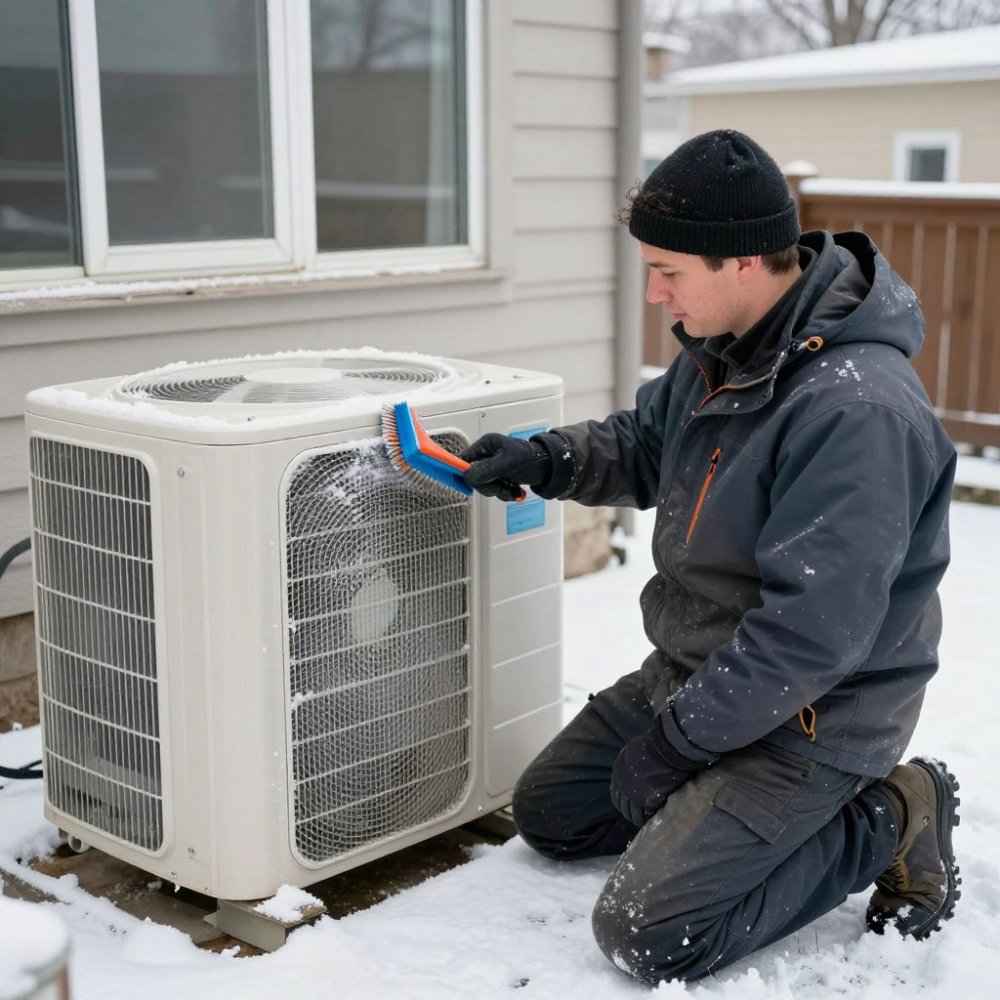
The biggest reason a heat pump struggles in cold weather is frost buildup on the outdoor coil. Frost blocks airflow, so the system runs a defrost cycle to melt it off. That cycle briefly reverses refrigerant flow and can look like the unit is “quitting,” but it is normal.
Cold-weather trouble is often tied to a few common causes:
- Defrost controls that work right. A stuck or faulty defrost cycle leaves frost on the coil and kills heat output.
- Proper refrigerant charge. Too little refrigerant means weak heat transfer and poor low-temperature operation.
- Good airflow. Snow, ice, or leaves packed around the unit choke the coil.
Defrost Cycles, Frost Buildup, and the Outdoor Coil
A thick sheet of ice on the outdoor coil that never clears is not normal frost and usually points to a defrost problem or low refrigerant.
Home insulation and air sealing matter too. A leaky house loses heat faster than any heat pump can replace it, so the system feels weak even when it is running fine.
Minimum Operating Temperature and Capacity: Reading the Real Numbers
The minimum operating temperature on a cold-climate heat pump is a real spec, and it tells you where the unit stops producing useful heat. But do not treat one number as universal. Two figures matter:
- Minimum operating temperature: the lowest outdoor temperature at which the unit will run at all.
- Design temperature: the coldest temperature your area typically sees, used to size the system.
Heating capacity falls as outdoor temperature drops, even on a cold-climate model. Judge a unit by its published capacity at the temperatures you actually get, not its best-case rating.
A common mistake is buying on the headline number alone. A unit rated to run at a very low minimum temperature may still put out weak heat at that temperature. Match the capacity curve to your climate.
How to Read a Capacity Table Like a Pro
Manufacturers publish performance data in tables that show heating capacity and coefficient of performance (COP) at several outdoor temperatures. Here is how to use them:
- Find your design temperature. The U.S. Department of Energy and ASHRAE publish design temperatures by location. Use the 99% heating design temperature for your area, not the coldest night on record.
- Locate that temperature in the table. If your design temperature is 5°F, look at the row for 5°F, not 47°F.
- Read the capacity at that temperature. This is the Btu per hour the unit can deliver when you need it most. Compare it to your home’s heat loss at design conditions.
- Check the COP at that temperature. A COP of 1.0 means the unit is no more efficient than electric resistance heat. Below 1.0, backup heat is cheaper to run.
- Distinguish “maximum capacity” from “rated capacity.” Rated capacity is what the unit can sustain; maximum is a short-term boost.
Sizing to the design temperature matters more than any single minimum operating temperature claim.
Ask for the capacity at your design temperature in writing.
What the Numbers Mean for Your Home
If a heat pump’s capacity at design temperature falls short of a home’s heat loss, backup heat covers the gap.
A properly sized cold-climate heat pump should cover most of your heating load without backup for all but the coldest hours of the year.
Ask your contractor to show you the capacity table and the load calculation side by side. If they cannot, find one who can.
What a Cold-Climate Heat Pump Costs and How to Judge the Price
Cold-climate heat pump cost depends on system size, the home, and whether ductwork or electrical work is needed. Judge any quote by what it includes.
Ask every contractor these questions:
- Is the quote based on a real load calculation for your home?
- Does it include any needed ductwork or electrical upgrades?
- Is backup heat included, and what kind?
For a side-by-side look at other heating choices and what drives their cost, see our guide to the best heating alternatives for homeowners. It covers contractor vetting and a repair estimate checklist so you can compare quotes on equal footing.
Cold-Climate Heat Pump Mini Split: Ductless Options for Older Homes
A ductless mini split is one option for older homes without ductwork. It mounts a head in each room and connects to an outdoor unit with a small line set, giving room-by-room control.
If you are weighing ductless options, our team installs and repairs these systems across the area. You can see our ductless mini-split installation and repair service to book a visit. It also helps to read up on the benefits of a ductless mini-split before you commit, and to compare the best HVAC system for old homes so the choice fits your house, not just the showroom.
Backup Heat, Sizing, and Your Cold-Snap Plan
Backup heat is your safety net, not a sign the heat pump failed. Many cold-climate systems pair with supplemental heating, such as electric resistance heat or a dual-fuel setup with a furnace. The heat pump carries the load most of the year, and backup kicks in on the handful of nights that push past its capacity.
A cold-snap plan should cover:
- Sizing that fits the home. A proper load calculation prevents both short-cycling and cold-weather shortfalls.
- A backup heat strategy. Decide whether you want electric resistance strips or a dual-fuel furnace.
- A watch on your existing furnace. If it is your backup, know the signs your furnace needs professional repair before it is called into duty.
Extreme cold exposes weak spots, so plan ahead before winter arrives.
How Backup Heat Actually Works
Modern cold-climate heat pumps use controls that decide when to bring on backup heat.
There are two main types of backup heat:
- Electric resistance strips: These are inexpensive to install but expensive to run. They convert electricity to heat at a COP of 1.0, while a heat pump might run at a COP of 2.0 or higher at the same temperature. Use them sparingly.
- Dual-fuel with a furnace: This pairs the heat pump with a gas, propane, or oil furnace. The furnace takes over when the heat pump cannot keep up. This is often the most cost-effective option in colder climates where electricity is expensive.
Some systems use a “dropped” balance point, where the heat pump keeps running and the furnace provides the difference.
Watch out: a common mistake is setting the balance point too high, which causes the backup heat to run more than necessary and drives up utility bills.
Sizing and Home Readiness Checklist
Before you request quotes, do these checks:
- Insulation and air sealing: A leaky house loses heat faster than a heat pump can replace it. Seal attic bypasses and add insulation for your climate zone.
- Ductwork: If you have ducts, have them tested for leakage, since leaky ducts waste heat the system produces.
- Heat loss calculation: Ask for a room-by-room load calculation based on your home’s construction, not a rule of thumb.
Cold-Snap Planning
During extreme cold, your system may run continuously and still struggle. That is normal. The key is to have a plan:
- Know the balance point and what temperature triggers backup heat.
- Keep the outdoor unit clear of snow and ice.
- Do not set back the thermostat aggressively during cold snaps; recovery may require backup heat.
A cold-climate heat pump is a reliable heating solution, but it works best when the home and the system are matched to the climate. Plan ahead, and you will stay comfortable through the worst of winter.
Schedule a Cold-Weather Assessment Before the Next Freeze
The real challenge is not whether a heat pump works in the cold. It is whether your system is set up to do it well.
At 1st Service HVAC, we are a family-owned business with the owner having over 45 years of HVAC experience. We provide honest, high-quality workmanship with a team of licensed professional HVAC technicians.
Call 1st Service HVAC to keep your home warm through every cold snap.
Frequently Asked Questions
Should you turn off the heat pump in very cold weather?
No. Turning it off removes the most efficient heat source your home has and forces the backup system to carry the whole load, which usually costs more. Modern cold-climate heat pump systems are built for low-temperature operation and will bring in supplemental heating on their own when needed. Instead of switching the system off, set a steady thermostat temperature and leave it. If you are worried about a specific cold snap, ask a technician to confirm your balance point and backup heat settings before winter arrives.
How cold is too cold for a heat pump?
There is no single number. Standard air-source heat pumps often lose meaningful heating capacity in the teens and single digits, while cold-climate heat pump models are rated to keep producing heat well below 0°F. What matters more is your local design temperature and whether the unit’s published capacity at that temperature covers your home’s heat loss. A system sized correctly for your house and climate will hold indoor comfort through the coldest days your area typically sees.
Do cold-climate heat pumps need a backup heating system?
Most installations include one, and it is usually electric resistance heat or a furnace in a dual-fuel system. Backup heat is not a sign the heat pump failed. It covers the gap when heating demand outruns heat output during extreme cold and gives the system a safety net. A technician can set the switchover point so the heat pump runs as the primary source for as much of the winter as possible, keeping electricity use and operating costs down.
Are cold-climate heat pumps more expensive than standard heat pumps?
They usually cost more upfront because of the larger compressor, enhanced vapor injection, and controls needed for low-temperature operation. Pricing depends on system size, ductwork condition, and whether you choose a ducted or ductless setup, so ask for a written quote rather than comparing headline figures.
Can a heat pump keep a home warm during a cold snap?
Yes, if the system was sized for your design temperature and your home’s heat loss. Cold-climate heat pump technology, including inverter-driven compressors and variable-speed operation, lets the unit hold capacity as outdoor temperatures fall. The practical steps are air sealing and insulation to cut heat loss, correct system sizing, and a backup heat strategy set up in advance.
