

Last Updated: October 30, 2026
Quick Summary
An AC maintenance checklist is worth the effort because a few hours of preventive work each season can help avoid some common emergency calls. Change your air filter every 30 to 90 days and clear debris from the outdoor condenser unit. Leave refrigerant, electrical, and gas work to a licensed technician.
- Change your air filter every 30 to 90 days, depending on pets, dust, and system use.
- Keep two feet of clearance on all sides of the outdoor condenser unit.
- Rinse condenser coils with a garden hose, never a pressure washer.
- Schedule a professional tune-up annually, ideally in spring before the cooling season.
- Shut the system off at the thermostat and pull the outdoor disconnect before outdoor work.
Table of Contents
- Why an AC Maintenance Checklist Matters for Homeowners
- AC Filter Replacement Frequency: How Often to Change It
- Your Spring AC Maintenance Checklist
- DIY AC Maintenance: Tasks You Can Safely Do Yourself
- What to Expect From a Professional AC Tune-Up
- Troubleshooting Common AC Symptoms and When to Call a Pro
- Schedule Your AC Tune-Up With 1st Service HVAC
- Frequently Asked Questions
Why an AC Maintenance Checklist Matters for Homeowners
An AC maintenance checklist is a simple, repeatable list of tasks that keeps your cooling system running well from spring through fall.
That extra strain shows up on your utility bill first, then as strange noises, then as a breakdown on the hottest weekend of the year.
Here’s the part most guides skip: your AC doesn’t fail all at once.
A few hours of preventive work each season can help avoid some common emergency calls.
AC Filter Replacement Frequency: How Often to Change It
Change your air filter every 30 to 90 days, depending on your home.
Filter replacement is the single highest-impact task on any AC maintenance checklist.
Use this guide to pick your interval:
- No pets, low dust: every 90 days
- One pet or seasonal allergies: every 60 days
- Multiple pets, smokers, or recent remodeling: every 30 days
- Thick pleated filters: follow the package rating, often 60-90 days
Check the filter size printed on the old filter’s frame before you buy. A loose filter lets air bypass it.
Watch out: running a filter past its limit strains the blower motor and can freeze the evaporator coil.
Your Spring AC Maintenance Checklist
Spring is when you wake the system up after winter. Run these tasks before the first hot week, ideally in April or May, so any problem surfaces while the weather is still mild and technicians are not booked solid.
- Replace the air filter before the first cooling cycle. Note the size on the old frame so the next swap is a one-trip job.
- Clear the outdoor condenser unit. Remove leaves, grass clippings, and debris. Keep two feet of clearance on all sides, and check that shrubs, fence panels, or stored items have not crept into that zone over the winter.
- Rinse the condenser coils with a garden hose. Never use a pressure washer; the fins bend easily and a bent fin block is a repair, not a cleaning.
- Check the condensate drain line. Pour a cup of water through it and confirm it drains. If it backs up, flush with a mix of water and a little distilled white vinegar before calling anyone.
- Test the thermostat. Switch from heat to cool and confirm the system responds. Replace the batteries even if the display looks fine.
- Walk the vents. Make sure no registers are blocked by furniture, rugs, or curtains. Closed or blocked registers raise static pressure and reduce airflow through the whole system.
- Look at visible ductwork for disconnected joints, crushed sections, or gaps at the plenum. Tape or mastic fixes at accessible joints are a homeowner task; anything inside a wall or ceiling is not.
- Listen for unusual noises during a test run. Rattling, grinding, or screeching during that first cycle is a signal to stop and diagnose before the season starts.
A Season-by-Season Schedule, Not Just a Spring List
Most checklists stop at spring. A practical schedule spreads the work across the year so nothing piles up in one weekend:
- Monthly (or every 30 days in heavy-use homes): check the filter. Hold it up to a light, if you cannot see through it, replace it. This is the single task that most affects airflow and coil health.
- Every 60-90 days: replace the filter on the interval that matches your household (see the filter section above).
- Spring (April-May): the full walkthrough above, condenser clearance, coil rinse, drain check, thermostat test, vent and duct inspection.
- Mid-summer (July): a five-minute recheck. Clear any new debris from the condenser, confirm the drain is still flowing, and look at the filter again. Peak-season dust and pollen load filters faster than shoulder-season conditions.
- Fall (September-October): before the first heating cycle, repeat the filter swap, clear the condenser one more time, and confirm the thermostat switches cleanly between modes. A fall check can help catch issues before winter.
Put the schedule on your phone calendar with reminders at the start of each season. A recurring reminder beats a paper list that gets buried in a drawer.
A spring walkthrough can help catch small issues before they become summer emergencies. Write down what you check and when. A simple log helps you spot patterns year to year, for example, a filter that clogs faster every summer may mean a duct leak or a return-air problem worth investigating.
Here is the season-by-season schedule the article recommends so maintenance work doesn’t pile up in one weekend.
| Timing | What to do |
|---|---|
| Monthly (or every 30 days in heavy-use homes) | Check the filter; replace if you cannot see light through it |
| Every 60-90 days | Replace the filter on the interval matching your household |
| Spring (April-May) | Full walkthrough: condenser clearance, coil rinse, drain check, thermostat test, vent and duct inspection |
| Mid-summer (July) | Five-minute recheck: clear condenser debris, confirm drain flow, check filter |
| Fall (September-October) | Repeat filter swap, clear condenser, confirm thermostat switches between modes |
| Annually | Professional tune-up, ideally in spring before the cooling season |
DIY AC Maintenance: Tasks You Can Safely Do Yourself
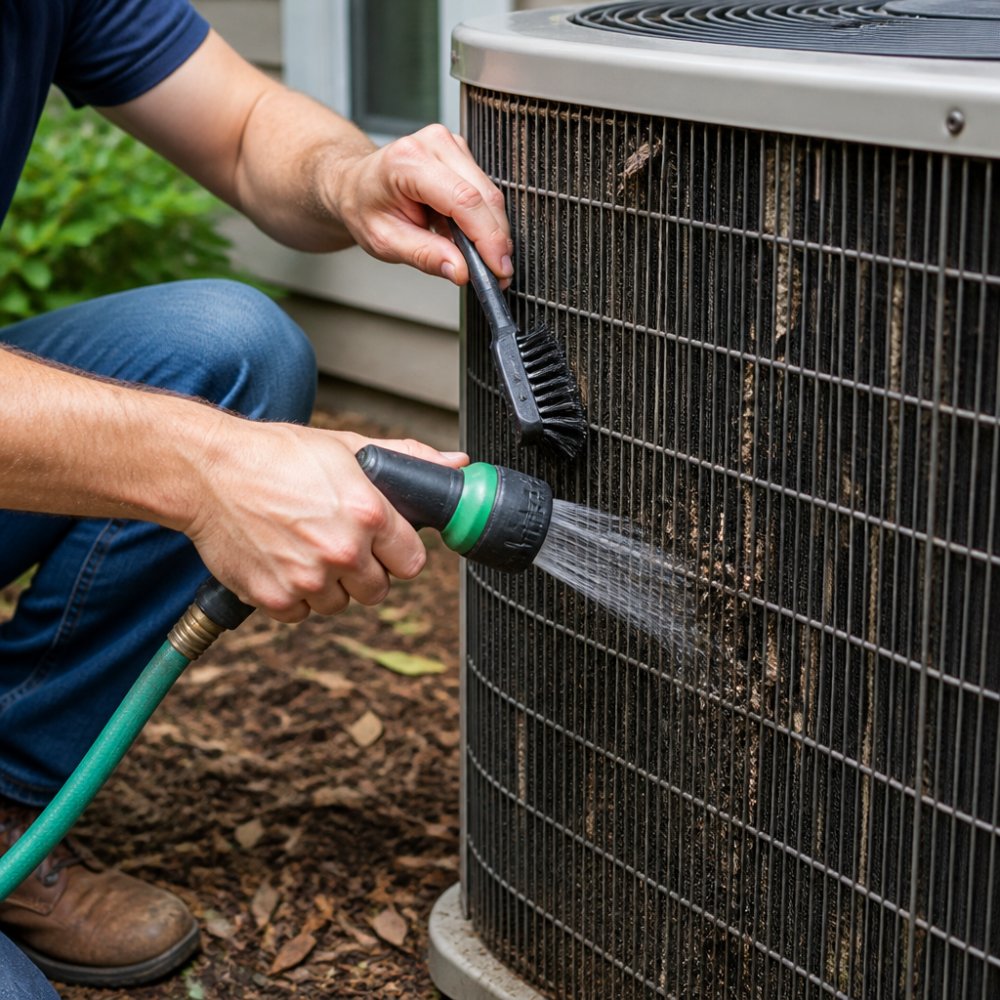
You can safely handle the low-risk tasks on this list. Leave anything involving refrigerant, electrical components, or gas lines to a licensed technician.
The Three Hazards That Define the DIY Line
1. Electrical hazard. The outdoor condenser and the indoor air handler both have capacitors that hold a charge after power is shut off at the breaker.
2. Refrigerant hazard. Refrigerant is regulated under federal law, and handling it requires certification under Section 608 of the Clean Air Act.
Reach out to us for more information… →
3. Gas and combustion hazard. If your system includes a gas furnace or a shared gas line, any work near that connection is a licensed-technician task.
Safe vs. Not Safe: A Clear Boundary
- Safe for most homeowners: filter swaps, condenser coil rinsing with a garden hose, debris clearing, thermostat battery and mode checks, vent and register clearing, condensate drain flushing, and visual inspection of accessible ductwork.
- Not safe: refrigerant handling, capacitor or contactor replacement, compressor work, gas line work, electrical panel checks, and anything that requires opening a sealed refrigerant circuit or a control box.
Before any outdoor work, shut the system off at the thermostat and pull the outdoor disconnect. Never rinse coils or clear debris with the unit running, the fan can start unexpectedly and the motor can be damaged.
The thermostat deserves its own minute. Set it to a reasonable cooling temperature, check the batteries, and confirm the fan runs in both auto and on modes. A thermostat with dead batteries mimics a broken system, and that false alarm is one of the most common unnecessary service calls.
When a DIY Check Should Become a Service Call
A DIY check is a triage step, not a repair. Escalate to a licensed technician when:
- The filter and vents are clear but airflow is still weak.
- The system runs but does not cool, or cools unevenly room to room.
- You see water near the indoor unit after flushing the drain.
- You hear grinding, screeching, or repeated clicking at startup.
- The system short-cycles, turning on and off in short bursts, which stresses the compressor.
What most guides miss is documentation. Note the date, the filter size, and anything odd you saw. That record helps a technician diagnose faster later, and it gives you a baseline to compare against next season. A simple notebook or a note on your phone is enough, the value is in the pattern, not the format.
What to Expect From a Professional AC Tune-Up
A professional AC tune-up is a deeper inspection than a homeowner can safely perform.
A professional tune-up typically involves steps such as:
- Refrigerant check: pressure testing and leak inspection
- Electrical inspection: tightening connections and testing capacitors
- Moving parts: lubricating motors and checking belts
- Coil cleaning: deep cleaning of evaporator and condenser coils
- Drain line: full flush and algae treatment
- System performance test: measuring temperature split and airflow
If you’re weighing a one-time visit against ongoing care, our guide to the benefits of annual HVAC maintenance plans explains how each option protects your system.
A good technician shows you what they found. Ask for photos of dirty coils or worn parts. Honest shops welcome the question.
Troubleshooting Common AC Symptoms and When to Call a Pro
Some symptoms have simple fixes. Others signal a problem only a licensed technician should touch. Here’s how to tell them apart.
- Weak airflow: check the filter and vents first. If both are clear, call a pro.
- Warm air from vents: confirm the thermostat is set to cool. If it is, this points to a refrigerant or compressor issue. Our breakdown of why your AC is blowing warm air covers the seven common causes.
- Water pooling near the indoor unit: a clogged condensate drain is the usual suspect. Flush the line. If it still backs up, call.
- Unusual noises: rattling suggests loose panels. Grinding or screeching means a motor or bearing issue. Stop the system and call.
- Short cycling: the system turns on and off rapidly. This stresses the compressor. Call a pro.
- Musty smell: this often means mold in the ductwork or drain pan. Call for an inspection.
If your system is blowing warm air and the filter is clean, don’t keep running it. You risk damaging the compressor, which is the most expensive part to replace.
Schedule Your AC Tune-Up With 1st Service HVAC
Consistent maintenance is what keeps a cooling system reliable. The tasks above can help protect your equipment between professional visits, but they don’t replace a professional tune-up.
That’s where we come in. 1st Service HVAC is family-owned, and our team brings decades of hands-on experience to every call.
If you want to lock in seasonal care, contact our team to ask about maintenance options. And if you want to see how maintenance pays off, read our guide on how to lower summer cooling bills.
Get started with 1st Service HVAC and keep your home cool all season.
Frequently Asked Questions
How often should I change my air conditioner filter?
Change standard 1-inch filters every 30 to 90 days. If you have pets, allergies, or live in a dusty area, aim for the 30-day end. High-efficiency pleated filters may last up to 90 days, but check monthly and replace when visibly dirty. A clogged filter restricts airflow, forcing the system to work harder and raising energy bills.
Can I clean my AC unit myself?
Yes, you can safely handle several DIY AC maintenance tasks: replace the filter, clear debris from the outdoor condenser, gently rinse the coils with a garden hose, and keep vents unobstructed. Avoid opening the refrigerant circuit, handling electrical components, or removing the blower assembly. Those jobs require a licensed technician and the right tools.
When should I schedule professional AC maintenance?
Schedule a professional AC tune-up in spring before the cooling season starts. If you missed spring, early summer is still fine. A technician will inspect the condenser coil, check refrigerant levels, test electrical connections, lubricate moving parts, and verify thermostat operation. Annual service helps catch small issues before they become costly breakdowns.
What AC maintenance tasks should homeowners avoid doing themselves?
Leave refrigerant handling, electrical repairs, and internal component cleaning to licensed professionals. Refrigerant is regulated and requires certification to handle. Attempting to recharge a system without training can damage the compressor or cause injury. Similarly, opening the electrical panel or adjusting wiring is dangerous. Stick to filter changes, outdoor debris clearing, and visual inspections.
Your AC works hardest on the days you need it most, and small maintenance gaps turn into big repair bills fast. 1st Service HVAC offers reliable AC repair, seasonal tune-ups, and energy-efficient system upgrades for homeowners across the area. Our licensed technicians handle all makes and models, and we’ll show you exactly what your system needs. Get started with 1st Service HVAC and enjoy year-round home comfort.
