Table of Contents
- Next Level Heating vs Superior Heating: What Homeowners Should Actually Compare
- How to Compare HVAC Quotes Without Getting Burned
- Questions to Ask an HVAC Contractor Before You Sign
- Signs of Dishonest HVAC Technicians and How to Protect Yourself
- Your HVAC Replacement Estimate Checklist
- Licensing, Insurance, and Warranty Terms That Separate Pros From Pretenders
- How 1st Service HVAC Approaches Heating and Cooling in Madison County
- Frequently Asked Questions
Last Updated: October 15, 2026
Next Level Heating vs Superior Heating: What Homeowners Should Actually Compare
When homeowners search for Next Level Heating vs Superior Heating, they usually want a simple verdict. The honest answer is that the name on the truck matters far less than the quote, the license, and the warranty behind the work, but that does not mean the two companies are interchangeable. A direct, evidence-based comparison of the two named providers is the one thing almost no page on this topic actually delivers, so here is how to build one yourself.
The Comparison Nobody Publishes
Most results for this query are listicles of local HVAC companies, review roundups, or generic “how to choose a contractor” guides. Almost none put Next Level Heating and Superior Heating side by side on the criteria that decide whether you are happy in year eight. That is the gap. You can close it in about twenty minutes with a phone call and a browser tab.
Run both companies through the same six questions and write the answers down:
- Legal entity and license number. Ask each company for its state HVAC license number and the exact legal name on the license. Then verify it through your state’s contractor licensing board lookup. A license tied to a different name than the one on the quote is a warning sign.
- Insurance certificates. Request a certificate of insurance showing general liability and workers’ compensation. Call the insurer listed on the certificate to confirm it is active, certificates can be forged or expired.
- Service area and response time. Ask which ZIP codes each company covers, whether they charge a trip fee outside that area, and what their stated response window is for a no-heat call in January versus a routine tune-up in April.
- Emergency and after-hours availability. Confirm whether after-hours calls reach a live dispatcher, an answering service, or a voicemail. Ask whether the after-hours rate is a flat fee or an hourly multiplier.
- Equipment brands and tiers they install. Ask which furnace and heat-pump brands each company is a factory-authorized dealer for, and whether they offer builder-grade, mid-range, and premium tiers or only one.
- Warranty structure. Get the labor warranty length in writing, separate from the manufacturer parts warranty, and ask whether the labor warranty transfers to a new homeowner if you sell.
Why the Same Furnace Can Perform Differently
Two companies can install the identical furnace and deliver completely different results. The difference sits in the details: how they sized the equipment, whether they pulled a permit, and what happens when the system fails in January.
A heating and cooling contractor is only as good as the process behind the install.
The U.S. Department of Energy guidance on home heating systems makes the same point: efficiency ratings only hold up when the equipment is matched to the home.
Build a two-column scorecard, one column per company, and fill it in during each sales visit. Whoever answers more of the six questions with a document instead of a promise is the stronger candidate, regardless of which name is on the truck.
How to Compare HVAC Quotes Without Getting Burned
The fastest way to compare HVAC quotes is to strip each one down to the same line items, then check what is missing. Apples-to-apples comparison is the only comparison worth making, and it is the step almost every ranking page skips in favor of vague “get three quotes” advice.
Most homeowners receive three quotes that look nothing alike. One lists a model number. Another lists a “complete system.” A third lists a lump sum with no breakdown at all. Comparing those documents is guesswork.
Here is how to fix that before you sign anything:
- Ask every contractor to quote the same equipment tier (builder-grade, mid-range, or premium)
- Request the exact model numbers for the furnace, air handler, and outdoor unit
- Confirm whether the price includes permit fees and haul-away of the old equipment
- Ask if the quote covers a manual load calculation or just a square-footage guess
- Get the labor warranty in writing, separate from the manufacturer warranty
What Actually Drives the Price Up or Down
Two quotes for the “same” job can differ by thousands of dollars, and the gap is rarely random. These are the variables that move the number:
- Equipment tier and efficiency rating. A builder-grade single-stage furnace and a premium variable-speed modulating furnace are different products at different price points. If one quote names a model and the other does not, you are not comparing prices, you are comparing guesses.
- System size and load calculation. A properly sized system costs more to specify (because someone has to do the room-by-room math) but less to operate. A square-footage guess is cheaper upfront and often wrong.
- Scope of work. Is the quote a straight swap, or does it include new line sets, a new pad, duct sealing, a condensate pump, or electrical upgrades? Those add-ons are where “cheaper” quotes quietly become more expensive.
- Permit and inspection. A permitted job includes a municipal inspection. An unpermitted job is cheaper today and a liability at resale.
- Labor warranty length. A one-year labor warranty and a ten-year labor warranty are not the same product. Ask for the length in writing.
Line Items Every Quote Should Include
A complete HVAC replacement estimate should list equipment, labor, permits, and warranty terms as separate lines. If a quote hides those behind one number, you cannot tell what you are actually buying.
The minimum you should see on paper:
| Line Item | What It Covers | Why It Matters |
|---|---|---|
| Equipment model numbers | Furnace, AC or heat pump, coil, air handler | Prevents substitutions after signing |
| Load calculation | Room-by-room sizing | Prevents oversized or undersized systems |
| Permit and inspection | Local code compliance | Protects you at resale |
| Labor warranty | Workmanship coverage | Covers install errors, not just parts |
| Manufacturer warranty | Parts and compressor coverage | Varies widely by brand and tier |
| Payment schedule | Milestone-based billing | Keeps leverage until the job is done |
If a contractor cannot produce that table, that is your answer.
Never compare a written quote against a verbal one. A verbal number is not a quote, it is a starting point for negotiation, and it usually moves in one direction: up.
Questions to Ask an HVAC Contractor Before You Sign
The right questions separate a dependable service company from a sales operation. Ask them before the contract, not after the install.
Start with licensing and insurance. Every legitimate contractor should be able to hand you a license number and a certificate of insurance on request. Then move to the technical side:
- Will you perform a manual J load calculation before recommending a system size?
- Who pulls the permit, and is the inspection included in the price?
- What is the labor warranty length, and does it transfer if I sell the house?
- How do you handle emergency calls on weekends and holidays?
- Can you service the brand you are recommending, or do you subcontract that work?
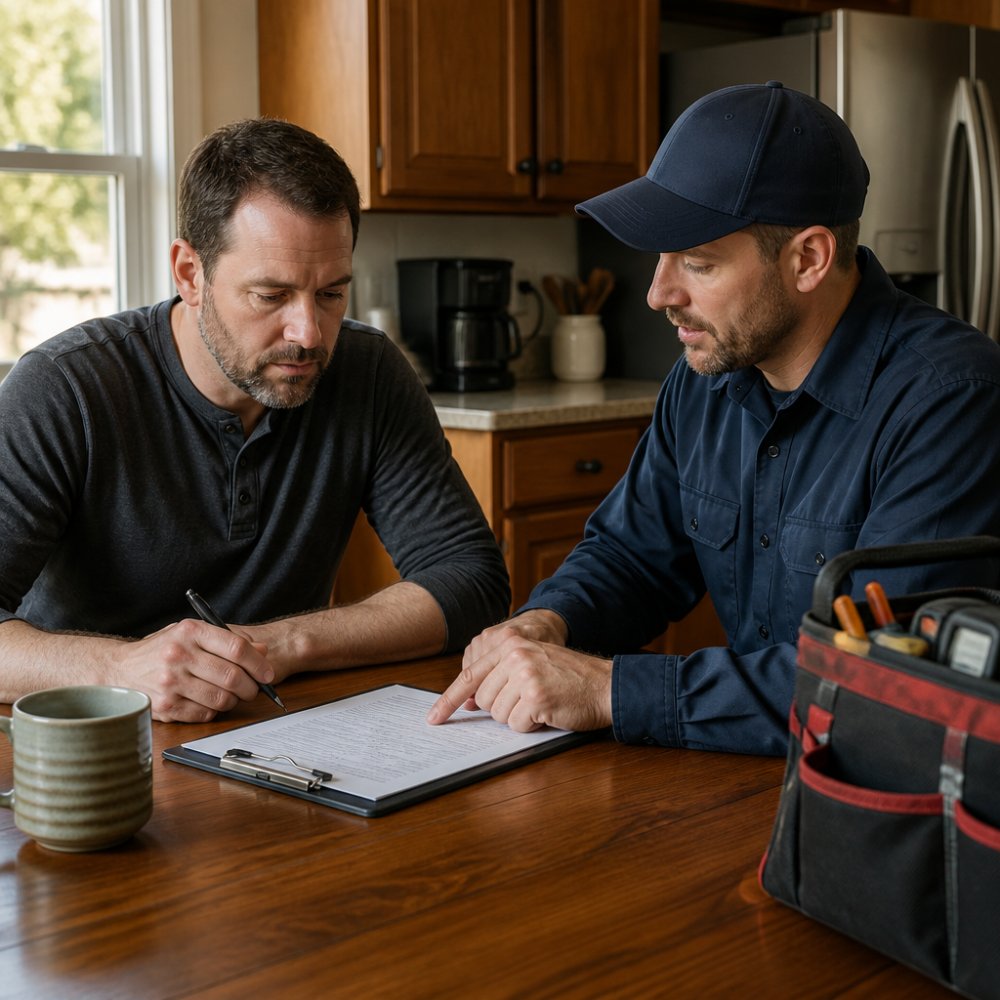
Ask for the license number and insurance certificate before the technician starts work, not after. A legitimate company will have both ready. A company that stalls is telling you something.
Signs of Dishonest HVAC Technicians and How to Protect Yourself
Recognizing the signs of dishonest HVAC technicians is easier than most homeowners expect. The pattern usually shows up in the first visit.
Watch for these red flags:
Reach out to us for more information… →
- A technician who diagnoses a failed compressor without gauges or a multimeter
- Pressure to replace a system that is still under manufacturer warranty
- No written estimate, only a verbal number that changes after work begins
- A quote that jumps significantly between the first call and the in-home visit
- Refusal to put warranty terms in writing
- A “today only” discount that disappears if you want a second opinion
One common mistake is treating urgency as expertise. A contractor who pressures you into a same-day decision is usually protecting a commission, not your comfort.
Never authorize work based on a verbal estimate alone. Without a written scope, you have no way to prove what was promised if the system fails or the price changes mid-job.
Your HVAC Replacement Estimate Checklist
An HVAC replacement estimate checklist keeps you from missing the details that cost money later. Print it, and run every quote through it.
- Exact model numbers for furnace, AC or heat pump, and air handler
- Manual J load calculation included and documented
- Permit fee and inspection listed as separate line items
- Labor warranty length stated in writing
- Manufacturer warranty terms and transferability confirmed
- Old equipment haul-away included
The Federal Trade Commission guidance on home improvement contracts is clear that written contracts protect both sides. Use that use.
Licensing, Insurance, and Warranty Terms That Separate Pros From Pretenders
Licensing and insurance are the two items homeowners skip and later regret. They are also the fastest filter for a reliable contractor.
A licensed HVAC contractor carries state-issued credentials and liability coverage. That coverage matters because a botched install can cause water damage, electrical problems, or carbon monoxide risks.
Warranty terms work the same way. Manufacturer warranties cover parts. Labor warranties cover the workmanship that put those parts in. A strong install carries both.
Ask for the labor warranty in writing before signing. A contractor confident in their workmanship will not hesitate. One who dodges the question is telling you how they handle callbacks.
How 1st Service HVAC Approaches Heating and Cooling in Madison County
At 1st Service HVAC, we built our process around the parts of HVAC work that homeowners cannot easily verify.
What that looks like in practice:
- Local knowledge. We know Richmond-area building styles and the environmental conditions that stress heating and cooling systems here.
- Fast response times. When your AC fails in July or your furnace quits in January, we move quickly.
- Honest service. We recommend repair when repair is the right call, and replacement only when it is genuinely needed.
- Year-round comfort. From AC repair to furnace maintenance to energy-efficient system upgrades, we handle the full cycle.
We work with homeowners, landlords, and small business owners across Madison County.
ENERGY STAR guidance on choosing qualified HVAC contractors
Comparing Next Level Heating, Superior Heating, or any other name on a quote is only useful when you know what to look for.
At 1st Service HVAC, we handle AC repair, furnace maintenance, and energy-efficient system installations for homeowners across Richmond and Madison County.
Frequently Asked Questions
How do I compare two HVAC contractors fairly?
Request written quotes from both companies on the same day so pricing reflects similar conditions. Ask each contractor to itemize equipment model numbers, labor, permits, and warranty terms. Compare the scope of work, not just the bottom line. A lower bid that excludes ductwork or uses builder-grade equipment is not actually cheaper. Check licensing and insurance for both, and read recent customer reviews to gauge reliability and communication.
What should an HVAC replacement estimate checklist include?
A complete estimate should list the equipment brand and model number, system capacity in tons or BTUs, labor costs, permit fees, disposal of the old unit, and any ductwork modifications. It should also state the warranty length for parts and labor, the expected installation timeline, and whether a manual J load calculation was performed. Ask for the estimate in writing and keep a copy for your records.
What are warning signs of a dishonest HVAC technician?
Watch for technicians who pressure you into a full system replacement when a repair would work, refuse to put quotes in writing, or claim a part is failing without showing you the reading. Other red flags include no visible license or insurance information, prices that change after the work starts, and no written warranty. A trustworthy contractor explains options, provides documentation, and never rushes your decision.
Should I get multiple estimates for HVAC replacement?
Yes. Getting at least two or three written estimates helps you understand fair market pricing and spot outliers. Compare equipment brands, efficiency ratings, warranty coverage, and installation methods, not just the total cost. Ask each contractor the same questions so you can evaluate them on equal footing. A contractor who welcomes your questions and provides clear documentation is usually the safer choice.