
Table of Contents
- Why Dishonest HVAC Technicians Target Homeowners
- Red Flags in HVAC Estimates: What a Bad Quote Looks Like
- Pressure Tactics and Urgency: When a Technician Won’t Let You Think
- Upselling Unnecessary Repairs and Replacing Working Parts
- Vague Technical Explanations and Unwillingness to Answer Direct Questions
- Questions to Ask HVAC Technician Before You Sign Anything
- When to Get an HVAC Second Opinion
- Conclusion
- Frequently Asked Questions
Last Updated: September 21, 2026
Why Dishonest HVAC Technicians Target Homeowners
Most homeowners know almost nothing about how an air conditioning system actually works, and dishonest HVAC technicians count on that gap. According to FBI common fraud schemes guidance, home improvement and repair fraud consistently ranks among the most reported consumer complaints, and heating and cooling work sits right in the middle of it. At 1st Service HVAC, we understand the frustration of families paying twice for the same repair because the first technician never fixed anything.
The reason this happens so often comes down to timing and trust. Your furnace dies in January, or your AC quits on a 95-degree afternoon, and you’re calling whoever answers. That urgency is exactly what a bad actor wants.
Recognizing the signs of dishonest HVAC technicians starts with understanding their playbook. Below, we break down the red flags that show up again and again, plus the exact questions and verification steps that protect your wallet.
Red Flags in HVAC Estimates: What a Bad Quote Looks Like
A dishonest estimate hides its details. An honest one spells out parts, labor, and total cost before anyone touches your system. If you can’t read a quote and understand exactly what you’re paying for, that’s your first warning.
No Written Estimate or Vague Line Items
Refusing to provide a written estimate is one of the clearest red flags in HVAC estimates. A legitimate contractor puts the scope of work in writing, including the diagnostic fee, parts and labor, and whether the price could change. A technician who says “we’ll figure it out as we go” is setting up a moving target.
Prices That Shift After the Work Starts
The quote says one number. The invoice says another. Sometimes the story is a “surprise” part that wasn’t visible during the inspection. Sometimes it’s vague labor hours. Either way, a price that climbs after the work begins usually means the original quote was never meant to be accurate.
Never authorize work on a verbal quote alone. If a technician refuses to put the scope and price in writing before starting, that is your signal to stop and get a second opinion.
Pressure Tactics and Urgency: When a Technician Won’t Let You Think
Pressure tactics work because they cut off your ability to compare. A technician who insists you must decide right now, today, before they leave the driveway, is not giving you a recommendation. They’re running a sales script.
Watch for these moves:
- “This price is only good if you sign today”
- “Your system is dangerous, we need to replace it immediately”
- “I can’t guarantee anything if you wait”
- A sudden “manager discount” that appears the moment you hesitate
Legitimate emergencies exist, and a real safety issue deserves fast action. But even then, a trustworthy HVAC contractor gives you the facts, the options, and time to decide. Urgency that disappears the second you ask for a written estimate was never about your safety.
Upselling Unnecessary Repairs and Replacing Working Parts
Replacing parts that still function is the most expensive trick in the book. A compressor with years of life left gets declared “on its last legs.” A furnace that needs a cleaning gets quoted as a full equipment replacement.
Here’s the tell: an honest technician explains what failed, why it failed, and what your repair versus replace options actually are. A dishonest one skips straight to the biggest invoice.
| Red Flag | What It Looks Like | What to Do |
|---|---|---|
| No written estimate | Verbal quote, vague line items | Ask for it in writing before work starts |
| Price shifts mid-job | Quote changes after work begins | Stop work, request itemized changes |
| Pressure to decide now | Today-only pricing, fear language | Walk away, get a second opinion |
| Unnecessary replacement | Working parts declared dead | Ask for the failed part and a written diagnosis |
| Vague explanations | Jargon instead of plain answers | Ask “explain that in plain English” |
Vague Technical Explanations and Unwillingness to Answer Direct Questions
If a technician can’t explain the problem in plain language, that’s a problem. Technical jargon used to confuse, not clarify, is a classic sign of dishonest HVAC work. You don’t need to be an engineer to deserve a straight answer.
Try this test. Ask: “Which part failed, why did it fail, and what happens if I don’t fix it today?” A professional answers all three without dodging.
Technical Jargon Used to Confuse, Not Explain
Terms like “refrigerant imbalance” or “compressor inefficiency” sound serious, but they mean nothing without specifics. A technician who hides behind jargon is usually hiding a thin diagnosis. Ask them to point at the actual part and show you the reading on their gauge.
Questions to Ask HVAC Technician Before You Sign Anything
Before you sign, ask these questions directly and write down the answers. A technician who dodges any of them is telling you something.
Reach out to us for more information… →
- Are you licensed and insured, and can I see the numbers?
- Will you give me a written estimate with parts and labor itemized?
- What exactly failed, and can you show me?
- What are my repair versus replace options?
- Is this an emergency, or can I get a second opinion first?
- What does your warranty cover, and for how long?
Digital Verification: How to Confirm a License in Five Minutes
Most guides tell you to “check the license” and stop there. Here is the actual process.
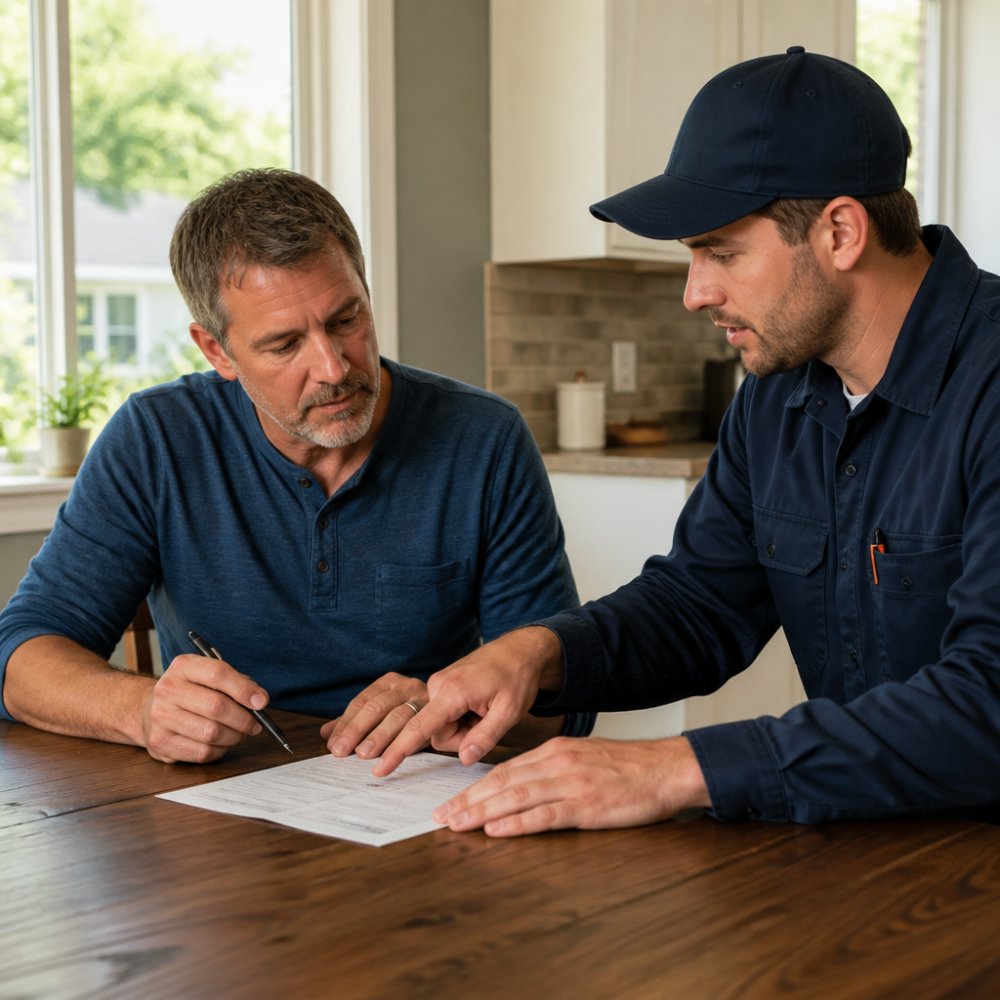
Step 1, Get the license number in writing. Ask the technician to write the company’s license number on the estimate, not just say it.
Ask for the failed part back. Honest technicians hand it over without hesitation. If someone gets defensive about a part they “already disposed of,” that’s worth noting.
Red Flags in Digital Marketing Before the Technician Arrives
You can screen a contractor before anyone knocks on your door. A few patterns are worth checking on the company’s Google Business Profile and review pages:
- A burst of five-star reviews in a short window with generic language (“great service,” “highly recommend”) and no specifics about the job.
- Reviewers with only one review on their profile, a common signature of purchased reviews.
- A business address that is a residence, a mailbox store, or a virtual office rather than a real shop or warehouse.
- No photos of actual work, only stock images or manufacturer marketing photos.
- A phone number that changes between the website, the Google listing, and the estimate.
When to Get an HVAC Second Opinion
Get an HVAC second opinion any time a quote feels too high, too urgent, or too vague. You are never obligated to accept the first diagnosis, even if you already paid a diagnostic fee. That fee buys you information, not a commitment.
A second opinion is especially worth it when:
- The quote involves full equipment replacement
- The technician pushed hard for an immediate decision
- The explanation didn’t make sense to you
- The price changed after work started
- The diagnosis arrived without any readings, photos, or a failed part shown to you
The Refrigerant Leak Scam, Explained
This is one of the most common HVAC scams, and it survives because most homeowners don’t know how refrigerant works. Refrigerant is not consumed like fuel. It circulates in a sealed system. If the level is low, refrigerant escaped through a leak, and the leak is still there.
Post-Service Audit: How to Read the Invoice After the Technician Leaves
None of the top guides explain this step, and it is where hidden markups live. Do the audit the same day, while the visit is fresh.
A written estimate before work, a written invoice after, and a five-minute license check before either one are the three habits that separate a protected homeowner from a targeted one.
Conclusion
Spotting the signs of dishonest HVAC technicians comes down to three habits: demand written estimates, ask direct questions, and never let urgency override your judgment. A contractor who resists any of those is telling you something important.
Frequently Asked Questions
How can I verify if an HVAC technician is licensed and insured?
Ask for the license number and insurance certificate before work begins. In most states you can look up a contractor’s license status through the state licensing board’s online database. A legitimate technician will hand over credentials without hesitation. If they dodge the question or promise to email it later, treat that as a serious warning sign. You can also call the insurance company directly to confirm the policy is active and covers HVAC work at your address.
Should I get a second opinion before authorizing expensive HVAC repairs?
Yes, especially when a technician recommends a full system replacement or a repair that costs more than a routine service call. An HVAC second opinion from a different licensed company often reveals whether the diagnosis holds up. Ask the second technician to inspect the same components and explain their findings independently. If both companies agree on the problem and the fix, you can proceed with confidence. If the stories do not match, you have saved yourself from a costly mistake.
What are the most common HVAC repair scams?
Common scams include adding refrigerant without fixing the underlying leak, claiming a compressor is dead when it only needs a capacitor, and pushing a new system when a repair would last years. Some technicians also inflate the diagnostic fee or bill for parts they never installed. Watch for cash-only demands, no written estimate, and pressure to decide on the spot. A trustworthy company provides parts and labor breakdowns, explains warranty coverage, and lets you review the estimate before any work starts.
How do I report a dishonest HVAC contractor?
Start by filing a complaint with your state licensing board, which can investigate and discipline the contractor. You can also report fraud to your state attorney general’s consumer protection division and leave a detailed review on trusted platforms. Keep copies of estimates, invoices, texts, and photos of the work. If you paid by credit card, you may be able to dispute the charge. Document everything before confronting the company, and never pay in full until the job is complete and verified.