
Last Updated: October 25, 2026
Quick Summary
Weekend emergency AC repair service is available for homes where indoor temperatures climb above 85°F, vulnerable people live in the home, or the system has stopped entirely. Call now for no cooling in 90°F-plus weather, a medical need, or safety signals like burning smells or tripping breakers.
- If indoor temperature stays under 80°F and the system runs but weak, wait for a weekday appointment.
- Morning calls between 7 a.m. and 10 a.m. fill first, so call early for faster weekend service.
- Ask for the service call fee, diagnostic fee, and after-hours labor rate before you agree to a visit.
- Never keep resetting a tripped breaker; repeated trips can turn a motor replacement into a fire risk.
- Expect a written estimate and your approval before any parts are ordered or work begins.
Table of Contents
- When a Weekend AC Failure Counts as an Emergency
- AC Emergency Warning Signs You Should Never Ignore
- AC Not Cooling Troubleshooting You Can Do Safely
- What to Do Before an AC Repair Appointment
- How AC Repair Response Time Works on Weekends
- Weekend and After-Hours Pricing: What Drives the Bill
- What Happens During an Emergency Repair Visit
- Schedule Your Weekend Emergency AC Repair Service
- Frequently Asked Questions
When a Weekend AC Failure Counts as an Emergency
A weekend AC failure counts as an emergency when indoor temperatures climb into dangerous territory, when vulnerable people live in the home, or when the system has stopped entirely rather than just struggling.
Here is the line we draw. If the indoor temperature is still under 80°F and the system is running but weak, you can usually wait for a weekday appointment.
The CDC heat and health guidance is blunt about why: heat illness escalates quickly indoors, especially in upstairs rooms and homes with poor ventilation. An air conditioning system that quits on a Saturday afternoon in July is not a convenience problem.
Three conditions make a weekend call the right call:
- No cooling at all in 90°F-plus weather, with indoor temps rising hour by hour
- A medical need in the household, including medications that impair heat regulation
- A safety signal from the equipment itself, such as burning smells, tripping breakers, or water pooling near electrical components
Anything short of that is usually a Monday-morning problem. Knowing the difference saves you an after-hours charge and frees up emergency slots for the homes that genuinely need them.
AC Emergency Warning Signs You Should Never Ignore
AC emergency warning signs fall into two groups: signs the system is failing, and signs the failure is becoming a hazard. The first group costs money. The second group costs money and safety.
Watch out for burning or plastic smells from the vents. That points to overheated wiring or a failing motor, and it is a shut-it-down-now signal, not a wait-and-see one.
Symptoms That Point to a Failing System
- Warm air from every vent while the thermostat calls for cooling
- Ice on the indoor coil or the outdoor refrigerant line, which means restricted airflow or a refrigerant problem
- Loud banging, grinding, or screeching from the outdoor unit
- Constant breaker trips when the compressor starts
- Water pooling around the indoor air handler
- The system short-cycles, running for a few minutes and shutting off repeatedly
Ice deserves its own note. Many homeowners see frost on the line set and assume the unit is working hard. It is the opposite. If you spot ice, a guide to why ice on your air conditioner matters explains what the frost is actually telling you before you decide whether to call.
AC Not Cooling Troubleshooting You Can Do Safely
AC not cooling troubleshooting starts with four checks that require no tools and no risk: thermostat settings, the air filter, the outdoor unit, and the breaker. Run these before you pick up the phone.
Check the thermostat first. Confirm it is set to COOL, the fan is on AUTO, and the setpoint is at least three degrees below room temperature. A bumped schedule or a dead battery in a smart thermostat causes a surprising share of “emergency” calls.
Then the filter. A clogged filter starves the system of airflow, which drops cooling capacity and can freeze the coil. If it looks gray and matted, swap it.
Look at the outdoor unit. Confirm the disconnect switch is on and the breaker at the panel has not tripped. Clear leaves and grass clippings from the sides, and keep a two-foot clearance around it.
Checks to Run Before You Call
- Thermostat set to COOL, fan on AUTO, setpoint below room temp
- Fresh filter installed, correct size and airflow direction
- Outdoor unit clear of debris, disconnect switch on
- Breaker reset once, not repeatedly
- Supply vents open and unobstructed by furniture
- Condensate drain line not clogged or overflowing
If the system still blows warm after all six, stop. Repeated breaker resets and refrigerant fiddling cause real damage. A breakdown of common causes of an AC blowing warm air covers what each symptom usually means, so you can describe the problem clearly when you call.
What to Do Before an AC Repair Appointment
Before an AC repair appointment, the goal is simple: keep the house livable, keep the equipment safe, and give the technician everything needed to fix it in one visit.
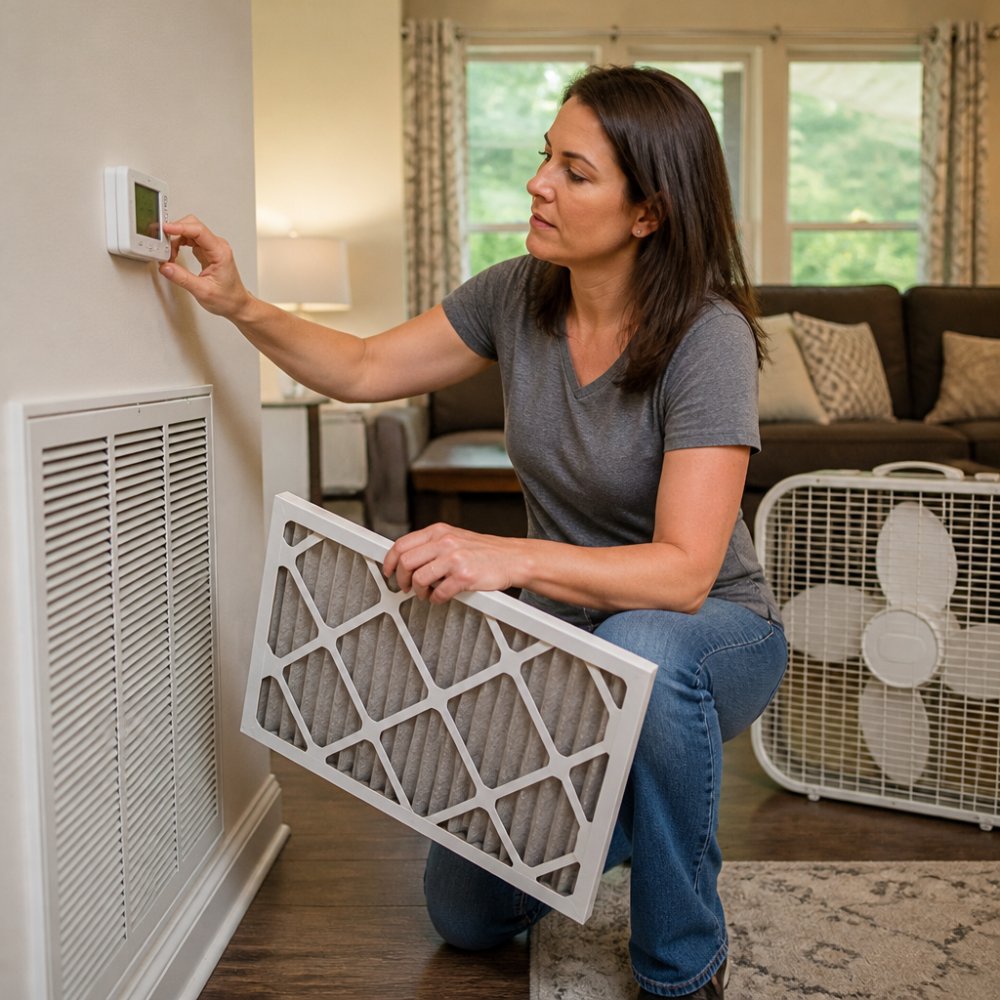
Start with heat management. Close blinds on sun-facing windows, run ceiling fans, and move the household to the lowest floor.
Then gather facts. Write down the thermostat setting, the indoor temperature, when the problem started, and any sounds or smells you noticed. Note the model and serial number from the outdoor unit.
Watch out: do not keep resetting a tripped breaker. A breaker that trips repeatedly is doing its job, and forcing it back on can turn a motor replacement into a fire risk.
Finally, clear a path. Move cars, pets, and clutter away from the outdoor unit and the indoor air handler.
How AC Repair Response Time Works on Weekends
AC repair response time on weekends depends on three variables: when you call, how the dispatcher triages, and whether the needed parts are on the truck. Most companies quote a window rather than an exact time, and the honest ones tell you where you sit in the queue.
Morning calls get faster service. A system that failed overnight is usually discovered by mid-morning, so the 7 a.m. to 10 a.m. window fills first. Calling Friday evening before a heat wave beats calling Saturday at noon.
Triage matters more than arrival order. A home with an infant and no cooling outranks a home with a weak system and a comfortable indoor temperature, even if the second caller dialed first.
Reach out to us for more information… →
Parts availability is the wild card. A capacitor or contactor is a common failure with a common fix. A failed compressor on a weekend can mean a temporary cooling solution while the replacement part is ordered.
Weekend and After-Hours Pricing: What Drives the Bill
Weekend and after-hours pricing reflects three cost drivers: the service call fee, the labor rate for unscheduled hours, and any diagnostic charge. Ask for all three before you agree to a visit. A reputable company states them up front, in writing if you ask.
The service call fee covers the truck roll. The diagnostic fee covers the technician’s time finding the fault. Some companies waive the diagnostic when you approve the repair, and some do not.
Before you book, ask three questions in this order: (1) What is the total service call and diagnostic fee, and is any of it credited toward the repair? (2) What is the after-hours labor rate per hour, and does it change on holidays? (3) Will I get a written estimate and approve it before any work begins? A company that answers all three clearly is a company you can trust with an urgent call.
What actually drives your total:
| Cost Driver | What It Covers | How to Control It |
|---|---|---|
| Service call fee | Truck roll and arrival | Ask if it is waived or credited with repair |
| Diagnostic fee | Fault-finding time | Confirm credit toward the repair |
| After-hours labor | Weekend or holiday rate | Ask for the hourly rate before booking |
| Parts | Failed components | Ask about warranty coverage on parts and labor |
| Refrigerant | Charge if a leak is found | Request a leak explanation and pressure test first |
A common pattern in the trade is a flat service call fee plus an hourly after-hours rate, with the diagnostic credited if you approve the repair. Some companies bundle the first hour of diagnosis into the service call.
Parts and refrigerant are the variables you cannot control, but you can control how they are presented.
Expect an estimate before work begins, approval before parts are ordered, and a clear statement of what is covered if the repair does not hold.
What Happens During an Emergency Repair Visit
An emergency repair visit follows a fixed sequence: safety check, diagnosis, repair estimate, approval, repair, and verification.
Step 2: Diagnosis. Expect a methodical test, not a guess.
Step 3: Estimate. You get an estimate before work begins. It should list the diagnosis in plain terms, the repair options, the parts, and the labor.
Step 4: Approval. Nothing should be ordered or installed until you approve.
Step 5: Repair. The technician performs the approved repair, confirms the part numbers, and explains what was replaced and why.
Step 6: Verification. The technician runs the system and confirms the temperature drop across the coil and that the system holds.
If a technician cannot explain the diagnosis in plain terms, will not put the estimate in writing, or pressures you to approve a replacement on the spot, stop. You are allowed to ask for time to decide, and a reputable company will respect that.
If the diagnosis points to a system near the end of its life, our team walks through the trade-offs, including efficiency gains from a modern system and what that means for summer utility bills.
Schedule Your Weekend Emergency AC Repair Service
When the house is heating up and the system has quit, the next step is a phone call, not another round of guessing. 1st Service HVAC is a family-owned business serving Richmond and the surrounding counties, with an owner who brings more than 45 years of HVAC experience and a team of licensed technicians.
We handle repair for all makes and models, and we will tell you plainly whether you are looking at a fix or a replacement. No pressure, no padded diagnosis.
Ready to get the house cool again? schedule your weekend emergency AC repair service online, or contact our team directly to arrange urgent weekend service. If you are weighing what counts as an emergency in your area, a guide to emergency AC repair in Madison County covers what to do first.
Frequently Asked Questions
What should I check before calling for emergency AC repair?
Check the thermostat batteries and settings, confirm the breaker has not tripped, and replace a clogged air filter. Look at the outdoor unit for blocked airflow or a tripped reset button. If the system still will not cool after these steps, call for emergency AC repair. Tell the dispatcher what you checked, the system age, and whether you hear any unusual noises so the technician arrives prepared.
How quickly can an emergency AC technician respond on a weekend?
AC repair response time depends on call volume, weather, and your distance from the dispatch center. Most weekend calls are scheduled within hours rather than days, and priority goes to homes with vulnerable residents or no cooling at all. When you call, ask for an arrival window and share your address and system details. A local, family-owned company with technicians already in the area usually reaches you faster than a regional call center.
What are the warning signs that my AC needs urgent repair?
Treat these as AC emergency warning signs: warm air from the vents, a system that will not turn on, repeated breaker trips, burning smells, ice on the indoor coil, water pooling near the unit, or loud grinding and squealing. Any burning smell or sparking means shut the system off and call immediately. Ignoring these signals can turn a small repair into a full system failure or a safety hazard.
Can I run my AC if it is not cooling?
Running an AC that is not cooling can make things worse. If the coil is frozen or the compressor is struggling, continued operation risks damage and higher repair costs. Shut the system off, let ice melt if present, and run fans to keep air moving. Then schedule service. A technician can diagnose whether the problem is refrigerant, airflow, or a failing component before it becomes an AC replacement decision.
A failed AC on a Saturday is stressful, and the last thing you need is a runaround. 1st Service HVAC offers fast response times, honest diagnosis, and repair for all makes and models, backed by a team that knows local homes and how they handle summer heat. Get started with 1st Service HVAC and get your cooling back before the weekend is over.
