
Table of Contents
- What Drives the Cost of HVAC System Replacement in 2026
- Factors Affecting HVAC Installation Cost
- HVAC System Types and Efficiency: Where Your Money Goes
- HVAC Tax Credits 2026 and Utility Rebates
- Does a Heat Pump Work in Cold Climates?
- Post-Installation Maintenance and Smart Home Integration Costs
- How to Get an Accurate HVAC System Replacement Quote
- Frequently Asked Questions
Last Updated: September 20, 2026
What Drives the Cost of HVAC System Replacement in 2026
The cost of HVAC system replacement in 2026 depends on three things: the equipment you choose, the labor and permits your project requires, and the hidden costs most homeowners never see coming. According to the U.S. Department of Energy’s heating and cooling guidance, heating and cooling account for roughly half of a typical home’s energy use, which is why the equipment you select matters far beyond the sticker price.
The Five Line Items on Every Replacement Quote
A replacement quote is a stack of line items, each moving independently. Here is how a typical project breaks down:
| Line Item | What It Covers | Share of Total Project |
|---|---|---|
| Equipment | Condenser, air handler or furnace, coil, line set | Largest single line |
| Labor | Removal, install, brazing, vacuum, charge, startup | Second-largest |
| Ductwork | Sealing, resizing, partial or full replacement | Highly variable |
| Permits and inspection | Municipal permit fee, inspection sign-off | Fixed per jurisdiction |
| Disposal and misc. | Haul-away, pad, disconnect, thermostat | Small but recurring |
Equipment and System Capacity
Equipment cost scales with capacity, measured in tonnage for cooling and BTU output for heating. A larger home needs a bigger condenser unit and air handler, and both cost more. Efficiency ratings push the price higher still: a higher SEER2 rating costs more upfront but uses less electricity every month, and a higher AFUE rating means more of every gas dollar becomes heat instead of exhaust.
- Single-stage vs. variable-speed. A single-stage compressor runs at one speed. A variable-speed inverter compressor modulates output, which improves comfort and efficiency but adds cost to the equipment line.
- Standard vs. cold-climate heat pump. Cold-climate units use enhanced vapor injection and variable-speed compressors to keep producing heat at low outdoor temperatures. That capability is engineered into the equipment, and it is priced into it.
Labor, Permits, and Hidden Costs
Labor is the second-largest line item and varies with job complexity. Replacing a split system in the same footprint takes less time than a full retrofit requiring new refrigerant lines and ductwork modification. Permits and inspection fees vary by jurisdiction, and hidden costs include ductwork repair, electrical panel upgrades, and sometimes a new condenser pad.
The most common surprise on an HVAC installation quote is ductwork. If your existing ducts leak or are undersized for the new system’s capacity, the contractor has to fix them before the equipment can run correctly. Ask for a duct inspection before you sign anything.
The 10-Year Total Cost of Ownership
The sticker price is the entry fee, not the cost. Over 10 years, the number that matters is total cost of ownership: equipment, installation, permits, maintenance, repairs, and energy. Two systems with the same install price can diverge sharply on energy and repairs.
- Estimated annual energy cost for each system at your utility’s rates.
- Annual maintenance, at least one professional tune-up per year.
- A repair reserve, a realistic allowance for the parts most likely to fail over a decade.
Factors Affecting HVAC Installation Cost
Four variables decide whether your project lands at the low or high end of the range: home size, ductwork condition, system type, and location.
Home Size, Ductwork, and System Type
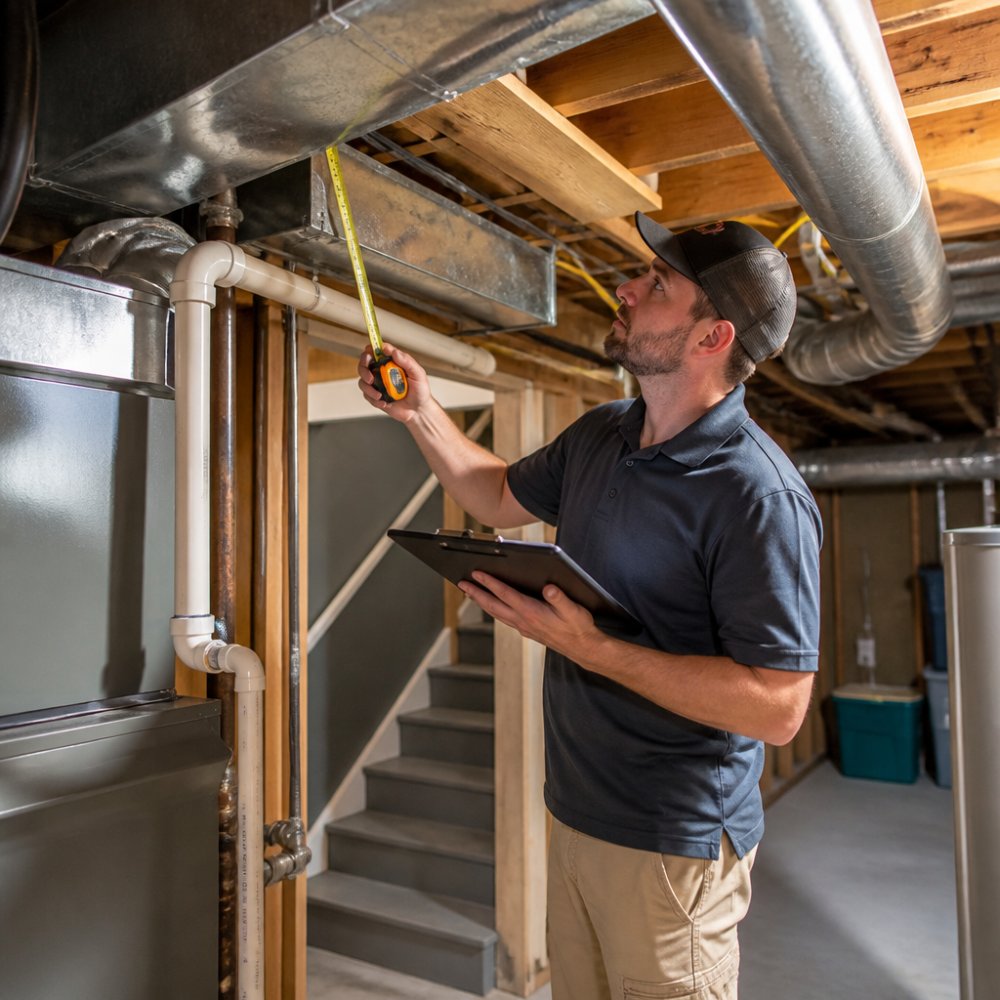
A larger home needs more capacity, and more capacity costs more. Ductwork matters just as much: properly sized existing ducts can often accept a new system with minimal modification, while failing ducts need partial or full replacement. System type is the third lever, a split system costs less to install than a ducted heat pump, which costs less than a ductless mini-split with multiple indoor heads.
Regional Cost Variance and Timing
Where you live changes the labor rate, permit fee, and demand curve. In markets with short cooling seasons, contractors are less busy in spring and fall, which means better scheduling and more competitive quotes; where summers are brutal, everyone calls at once in July and prices reflect it. Timing your replacement in the shoulder season is one of the few levers you fully control.
HVAC System Types and Efficiency: Where Your Money Goes
Each system type trades upfront cost against long-term efficiency. Here’s how the main options compare.
| System Type | Relative Upfront Cost | Best For | Key Trade-off |
|---|---|---|---|
| Split system | Lowest | Homes with existing ductwork | Least efficient in extreme cold |
| Ducted heat pump | Moderate | Year-round efficiency | Higher install complexity |
| Ductless mini-split | Highest | Homes without ducts | Multiple indoor heads add cost |
Ask your contractor for a load calculation before anyone quotes a system. A proper load calculation sizes the equipment to your home instead of guessing from square footage. An oversized system short-cycles, wears out faster, and never removes humidity properly.
HVAC Tax Credits 2026 and Utility Rebates
Federal tax credits and utility rebates can offset a meaningful share of your total project cost, but the amounts and eligibility rules change. The IRS guidance on energy-efficient home improvements and the ENERGY STAR federal tax credit overview are the authoritative sources for current amounts and qualifying equipment. Utility rebates are separate and vary by provider, so check with your local utility before you buy.
Does a Heat Pump Work in Cold Climates?
Yes, a modern heat pump works in cold climates, and the old objection that they quit below freezing no longer holds. Cold-climate heat pumps use variable-speed compressors and enhanced vapor injection to keep producing heat at low outdoor temperatures. The catch: efficiency drops as temperatures fall, so in the coldest stretches the system leans on a backup heat source, usually electric resistance or a gas furnace.
Reach out to us for more information… →
Post-Installation Maintenance and Smart Home Integration Costs
The purchase price isn’t the end of the spending. Most guides stop at the install quote, which is why the 10-year total cost of ownership is the number that actually matters. Here is what the ongoing lines look like.
Annual Maintenance: The Recurring Line
Preventative maintenance keeps the system running at its rated efficiency and extends its lifespan. Plan on at least one professional tune-up per year, plus filter changes every one to three months. Skipping maintenance is the fastest way to shorten the life of a new system.
Smart Thermostats: The Most Common Add-On
Smart home integration adds another line. A smart thermostat is the most common upgrade and pays for itself through better scheduling and fewer wasted run hours: it learns your schedule, reduces run time when the house is empty, and gives you remote control when you’re away. Runtime is what you pay for.
Zoning Controls: When One System Serves Many Areas
Some homeowners add zoning controls, which let a single system serve different areas at different temperatures. Zoning uses motorized ductwork dampers and a zone control panel, adding cost on both the equipment and ductwork lines. It makes the most sense in a two-story home with a persistent temperature split or rarely used rooms, and the least sense in a small, open floor plan that’s already even.
Building the 10-Year TCO Table
To compare two quotes honestly, build a table with four rows: install cost, estimated 10-year energy cost, estimated 10-year maintenance, and a repair reserve. Add them up. The lower install price doesn’t always win, and neither does the higher efficiency, it depends on your climate, utility rates, and how long you plan to stay.
Budget for maintenance the same way you budget for the equipment. A system that gets annual tune-ups typically lasts longer and holds its efficiency better than one that only gets attention when it breaks. Add the smart thermostat and any zoning controls to the same table, and compare the 10-year total, not the install quote.
How to Get an Accurate HVAC System Replacement Quote
An accurate quote comes from an on-site evaluation, not a phone call. Any contractor who quotes a replacement without measuring your home, inspecting your ducts, and running a load calculation is guessing. A legitimate quote should include:
- Equipment model numbers and efficiency ratings (SEER2, AFUE)
- System capacity in tonnage and BTU output
- Load calculation results for your home
- Ductwork inspection findings and any needed modification
- Permit and inspection fees, itemized
- Labor breakdown and estimated timeline
- Warranty terms for parts and labor
- Whether the quote includes hauling away the old equipment
Frequently Asked Questions
Will HVAC systems cost more in 2026?
Equipment prices typically rise each year with inflation, refrigerant regulation changes, and supply chain shifts. The cost of HVAC system replacement in 2026 depends on the system type, capacity, and efficiency rating you choose, plus local labor rates. Higher-efficiency units and heat pumps generally cost more upfront but may qualify for federal tax credits that offset part of the price.
What is the $5,000 rule for HVAC?
The $5,000 rule is a rough guideline some homeowners use: if a repair costs more than $5,000, or more than half the price of a new system, replacement may make more financial sense. It is not a hard rule. Age, efficiency, repair frequency, and remaining system lifespan all matter. A qualified contractor can compare repair versus replacement costs for your specific unit.
Does a heat pump work in cold climates?
Yes. Modern cold-climate heat pumps can heat effectively at temperatures well below freezing, and many are rated for operation down to -13°F or lower. Performance drops as temperatures fall, so contractors often pair a heat pump with a backup furnace or use a dual-fuel setup. Proper sizing through a load calculation is essential for cold-weather performance.
What federal tax credits are available for HVAC replacement in 2026?
The federal Energy Efficient Home Improvement Credit (Section 25C) offers up to $2,000 for qualifying heat pumps and heat pump water heaters, and up to $600 for qualifying furnaces, central air conditioners, and boilers. Annual caps apply. Utility rebates may stack on top. Confirm current eligibility and paperwork requirements with a licensed contractor before your installation.
How much is a new HVAC system for a 2,000 sq ft house?
Pricing depends on system type, efficiency rating, ductwork condition, labor rates, and whether you need a full HVAC retrofit or just an equipment swap. A 2,000 sq ft home usually needs a system sized around 3 to 4 tons, which affects equipment cost. Request an in-home quote with a load calculation so the estimate reflects your actual home, not a generic average.