
Last Updated: November 1, 2026
Quick Summary
Commercial HVAC maintenance is the scheduled inspection, cleaning, testing, and calibration of every component in a building’s heating, ventilation, and air conditioning system, performed to keep equipment running efficiently and prevent breakdowns. A proper visit covers the whole system, from air-handling units and coils to controls, electrical components, and drainage.
- Schedule cooling work in spring and heating work in fall so neither season’s equipment goes a full year uninspected.
- A useful checklist records measurable readings against pass criteria, not just checkmarks.
- A service plan should state visit frequency, per-visit task list, parts and labor terms, and emergency response times.
- Ask for a sample service report before signing to confirm each component, reading, and range is documented.
- Refrigerant work requires certified technicians, tracked refrigerant use, and leak repairs within required timeframes.
Table of Contents
- What Commercial HVAC Maintenance Covers
- Why Commercial HVAC Preventive Maintenance Pays Off
- Building a Commercial HVAC Maintenance Schedule That Fits Your Facility
- The Commercial HVAC Maintenance Checklist With Pass/Fail Criteria
- What a Commercial HVAC Service Plan Should Include
- Compliance, Refrigerant Management, and Safety Responsibilities
- How to Evaluate a Commercial HVAC Contractor
- Setting Up a Maintenance Agreement With 1st Service HVAC
- Frequently Asked Questions
What Commercial HVAC Maintenance Covers
Commercial HVAC maintenance is the scheduled inspection, cleaning, testing, and calibration of every component in a building’s heating, ventilation, and air conditioning system, performed to keep equipment running efficiently and prevent breakdowns. A proper visit touches the whole system, not just the part that stopped working.
The scope separates a real service agreement from a cheap filter change. Here is what belongs in a full system inspection.
The Core Tasks in Every Full System Inspection
- Air-handling units: belt tension, blower wheel condition, bearing wear, cabinet seals
- Evaporator and condenser coils: cleaning, fin straightening, airflow verification
- Refrigerant circuit: pressure readings, superheat and subcooling checks, leak inspection
- Heating components: heat exchanger inspection, burner adjustment, ignition testing
- Controls: thermostat calibration, sensor verification, economizer operation
- Electrical: contactor pitting, capacitor readings, amp draw against nameplate
- Drainage: condensate pan cleaning, trap clearing, drain line flow testing
A common mistake is signing a plan that lists “inspection” without naming components. Ask for the written task list before you sign anything.
Why Commercial HVAC Preventive Maintenance Pays Off
Preventive maintenance pays off because it moves spending from emergency repairs to planned work. A compressor that fails on a July afternoon costs far more than the same fault caught during a spring visit, when the part can be ordered and the repair scheduled around your operating hours.
The logic is straightforward. For a deeper breakdown of the concrete benefits and ROI of annual maintenance plans, see our guide to the benefits of annual HVAC maintenance plans. Dirty coils and restricted airflow force equipment to run longer to hit the same setpoint.
Business facilities carry an extra burden: downtime. A retail floor or restaurant without cooling does not just feel uncomfortable, it stops earning. Documented preventive maintenance is how you keep system reliability predictable instead of reactive.
Building a Commercial HVAC Maintenance Schedule That Fits Your Facility
There is no universal commercial HVAC maintenance schedule. The right frequency depends on building type, equipment load, and how the space is used. A professional inspection cadence that suits a light-use office will not protect a kitchen running exhaust fans and makeup air units twelve hours a day.
Visit frequency depends on the building. Here is how to think about it:
Seasonal Timing: Spring and Fall Tune-Ups
The timing matters more than most owners realize. Scheduling cooling work in April means a failed capacitor gets replaced before it strands a full building in June. Watch out: booking both visits in the same month leaves the other season’s equipment uninspected for a full year.
The Commercial HVAC Maintenance Checklist With Pass/Fail Criteria
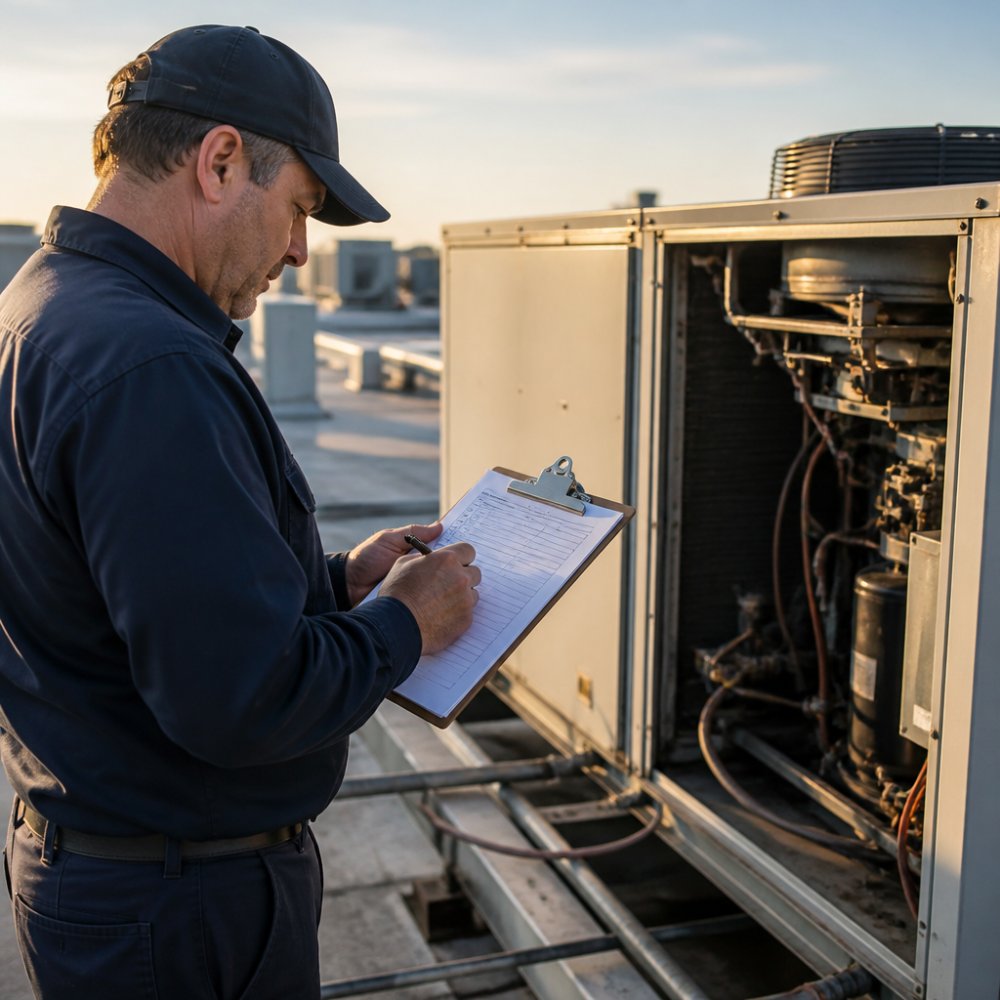
A useful commercial HVAC maintenance checklist records measurable results, not just checkmarks.
Measurable Benchmarks for Filters, Coils, and Refrigerant
| Component | Check | Pass Criteria | Fail Action |
|---|---|---|---|
| Air filter | Pressure drop | Within manufacturer spec | Replace and record reading |
| Evaporator coil | Visual + airflow | Clean fins, airflow at design | Clean, straighten fins |
| Condenser coil | Visual | No debris, clear fins | Clean coil |
| Refrigerant | Superheat/subcooling | Within manufacturer range | Leak search, then charge |
| Blower | Amp draw | At or below nameplate | Investigate bearings, belt |
| Thermostat | Calibration | Within 2°F of reference | Recalibrate or replace |
| Condensate drain | Flow test | Drains freely | Clear trap and line |
| Heat exchanger | Visual + combustion | No cracks, CO within spec | Shut down, escalate |
What a Commercial HVAC Service Plan Should Include
A commercial HVAC service plan should spell out visit frequency, the exact task list per visit, labor and parts coverage, emergency response times, and what happens when a repair is needed. If any of those are vague, the plan is a discount coupon, not a service agreement.
Maintenance plans generally vary in how visits, labor, and parts are covered, so compare the terms carefully before choosing. If cost is a concern, financing is available for the service agreement.
A plan is only comparable to another plan when the task list, the visit count, and the parts-and-labor terms are laid out side by side.
What to Demand in Writing
Before signing any agreement, ask for these terms in writing: visit count and timing, the per-visit task list, parts and labor terms, emergency response terms, documentation, contract length, and exclusions.
That last item is the one owners skip. A plan that lists what is included but never states exclusions is telling you the exclusions are wherever the contractor wants them to be.
How to Compare Proposals Without Getting Lost in Price
When you have two or three proposals in front of you, normalize them before you compare the bottom line:
- Count the visits. A plan with two visits is not cheaper than a plan with four if your building needs four.
- Price the consumables. Ask what filters and belts cost per visit if they are not included, and multiply by the visit count.
- Check the emergency terms. Response time, after-hours rates, and whether emergency visits count against a cap matter more in a restaurant or medical space than in a warehouse.
- Read the documentation clause. If the plan does not commit to written readings, you will not be able to trend performance or prove maintenance history later.
When comparing plans, check where any lower price comes from, such as fewer visits or a shorter task list, before comparing the price.
Reach out to us for more information… →
Compliance, Refrigerant Management, and Safety Responsibilities
Refrigerant handling is regulated, and the responsibility sits with the building owner as much as the contractor. Under EPA regulations on refrigerant management under Section 608, technicians who service refrigerant circuits must be certified, refrigerant use must be tracked, and leaks above set thresholds must be repaired within required timeframes. Those thresholds and deadlines change, so confirm current requirements with the EPA rather than relying on a contractor’s summary.
Beyond refrigerant, three responsibilities recur:
- Combustion safety: heat exchangers and flue venting checked for cracks and proper draft
- Electrical safety: disconnects, grounding, and motor overloads verified
- Records: service logs that document what was found, what was measured, and what was corrected
Maintenance records can serve as evidence if a warranty claim is disputed or an insurer asks how the equipment was maintained.
How to Evaluate a Commercial HVAC Contractor
Evaluating a commercial HVAC contractor comes down to four things: licensing and insurance, the depth of the proposed task list, how they document work, and whether they explain findings in plain terms. A contractor who cannot produce a written task list before the first visit will not produce one after it.
Most owners evaluate on price and availability. The contractors that cause the most trouble later are rarely the cheapest, they are the ones whose qualifications and reporting were never checked. A short framework closes that gap.
The Four Checks That Matter
1. Licensing and refrigerant certification. Commercial work requires properly licensed technicians, and any technician who services refrigerant circuits must hold the certification required under EPA regulations on refrigerant management under Section 608.
2. Insurance and bonding. Request a certificate of insurance showing general liability and workers’ compensation coverage, and confirm the limits are appropriate for commercial work. A contractor without current coverage exposes you to liability if a technician is injured on your property.
3. Response commitments in writing. Ask for the specific response window for emergency calls during business hours and after hours, and whether weekends are covered. “Priority service” without a stated window is not a commitment.
4. Reporting and documentation. Ask to see a sample service report before you sign. A useful report lists each component checked, the reading taken, the acceptable range, and any action recommended.
Questions Worth Asking Before You Sign
- Are your technicians licensed and certified for refrigerant work, and can I see the certificates?
- Can I see the per-visit task list in writing?
- What documentation do I receive after each visit, and can I see a sample?
- What is your emergency response commitment, including weekends?
- Will you recommend repair only after showing me the reading that justifies it?
- Who is my named service contact, and how do I reach them after hours?
That fifth question matters. Owners tell us they have been pushed into replacements they did not need, and the fear is fair. A contractor who shows you the amp draw or the pressure reading and explains what it means is a contractor worth keeping.
Red Flags in the Evaluation Process
A few patterns are worth walking away from:
- A proposal that quotes a monthly price before anyone has walked the building
- A task list that says “inspect system” without naming components
- No sample report available on request
- Vague or verbal-only emergency response terms
- Pressure to sign a multi-year agreement on the first visit
If you want to talk through your building’s situation, you can contact our team with questions before committing to anything.
Setting Up a Maintenance Agreement With 1st Service HVAC
Setting up a maintenance agreement starts with a walkthrough, not a sales pitch. We look at your equipment, its age and condition, how the building is used, and what your last service records show. From there we propose a visit schedule and task list matched to your facility, and you get the plan in writing before anything is signed.
As a family-owned business with over 45 years of HVAC experience behind it, we serve homeowners and businesses in Richmond, KY and the surrounding counties. You can check our areas we serve to confirm we cover your business location. Our technicians are licensed professionals dedicated to honest, high-quality workmanship.
Frequently Asked Questions
What does commercial HVAC maintenance include?
A general commercial maintenance visit can include air filter replacement, coil cleaning, blower and belt inspection, thermostat calibration, and refrigerant checks. Scope varies by system and should be confirmed with the service provider. The goal is to confirm the whole system, from air-handling unit to compressor, is running within manufacturer specifications before a small issue becomes an emergency service call.
How often should a commercial HVAC system be serviced?
Service frequency depends on the building, its equipment, and how it is used. Ask your service provider to recommend a schedule for your facility. Your commercial HVAC maintenance schedule should also account for equipment age and building type. Older rooftop units and direct-expansion equipment usually need closer monitoring than newer, well-maintained systems.
Can businesses handle any HVAC maintenance themselves?
In-house staff can safely change air filters, keep condenser coils clear of debris, and confirm thermostats hold setpoints. Anything involving refrigerant handling, electrical components, gas-fired furnace parts, or opening a compressor circuit requires a licensed technician. Federal rules under the Clean Air Act govern refrigerant handling, so refrigerant levels and leak checks belong with certified professionals. A practical split is to let staff handle filter replacement between visits and leave testing, calibrating, and repairs to the service provider.
What are the signs a commercial HVAC system needs service before its next scheduled visit?
Watch for rising energy bills without a usage change, uneven temperatures across zones, unusual noise from the blower or compressor, water pooling near an air-handling unit, and frequent thermostat adjustments that never satisfy the space. Short cycling and weak airflow point to filter loading, coil fouling, or low refrigerant. Any of these warrants a call rather than waiting for the next seasonal maintenance window, since early repair usually costs less than breakdown prevention after a failure.
If your building’s equipment is running longer, costing more, or failing at the worst possible time, the fix usually starts with a documented maintenance schedule rather than a rushed repair. 1st Service HVAC offers scheduled preventive visits, written service reports with actual readings, and priority response when something does go down. Get started with 1st Service HVAC and put your commercial system on a maintenance plan built around how your building actually runs.
