Table of Contents
- Landlord vs Tenant HVAC Responsibility: Who Handles What
- HVAC Preventative Maintenance Checklist for Landlords
- How Often to Service Rental Property HVAC Systems
- Emergency vs. Routine Repairs: Definitions and Lease Clauses
- Smart Thermostats and Energy Efficiency Tax Incentives
- HVAC Maintenance for Rental Properties: Cost-Benefit Analysis
- Frequently Asked Questions
Last Updated: September 23, 2026
Landlord vs Tenant HVAC Responsibility: Who Handles What
HVAC maintenance for rental properties works best when both sides know exactly where their duties end and begin. The short answer: landlords own the system and its major repairs, tenants handle the filters and the daily care. Everything in between is where leases get argued over.
Landlord Obligations Under Habitability Laws
State habitability laws require landlords to maintain a working heating system and safe, functioning utilities for the entire lease term. Cooling requirements vary by state, but most jurisdictions treat a broken system in extreme heat as a habitability issue too.
Landlord duties typically include:
- Annual furnace inspection and HVAC tune-up by a licensed technician
- All repairs to the heating and cooling equipment itself
- Filter replacement if the lease assigns it to the landlord
- Prompt response to any condition that makes the unit unsafe or unlivable
Tenant Responsibilities for Daily HVAC Care
Tenant responsibilities cover the cheap, frequent tasks that keep a system alive between professional visits. These belong in the lease agreement in plain language.
- Replace or clean filters on the schedule the lease specifies
- Keep supply and return vents unblocked by furniture or rugs
- Clear debris from around the outdoor unit
- Report strange noises, weak airflow, or temperature swings immediately
- Never attempt repairs or remove panels
A tenant who ignores a clogged filter for a full season can restrict airflow enough to freeze the evaporator coil. That turns a routine filter replacement into a repair bill, and it’s the dispute landlords win least often because the lease rarely spells out the filter schedule.
HVAC Preventative Maintenance Checklist for Landlords
An HVAC preventative maintenance checklist for landlords turns scattered repairs into a predictable calendar. The goal is simple: catch small problems before they become emergency calls at the worst possible hour.
Monthly and Seasonal Tasks
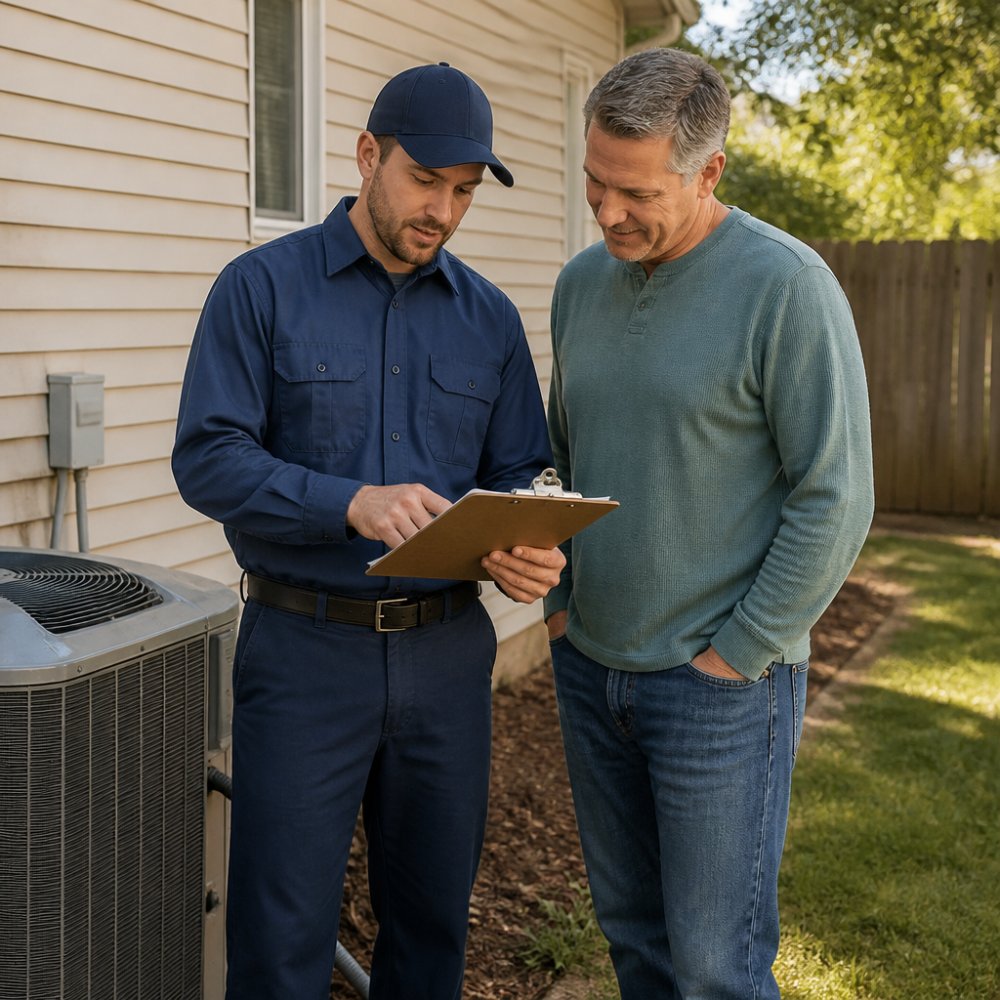
Monthly tasks take minutes and belong to the tenant. Seasonal tasks belong to the landlord and a licensed technician.
- Monthly: Tenant inspects and replaces the filter
- Monthly: Tenant checks the condensate drain for clogs
- Seasonal: Technician performs an annual tune-up before heating and cooling season
- Seasonal: Landlord clears outdoor unit debris and checks for refrigerant line damage
- Seasonal: Verify thermostat calibration after any battery change
How Often to Service Rental Property HVAC Systems
Service rental property HVAC systems once a year at minimum, ideally twice: a furnace inspection in fall and an AC check in spring. A system that runs year-round under tenant use benefits from both visits, and most manufacturers condition their equipment warranties on documented annual service by a licensed technician.
The table below shows what each interval actually covers.
| Interval | Task | Who Handles It |
|---|---|---|
| Monthly | Filter replacement | Tenant |
| Monthly | Condensate drain check | Tenant |
| Seasonal | Outdoor unit debris clearing | Landlord |
| Annual | Full tune-up and inspection | Licensed technician |
| Annual | Thermostat calibration | Licensed technician |
A Month-by-Month Maintenance Calendar
A generic “service it once a year” rule is where most landlords stop, and it is why so many systems fail early. The schedule below assigns every task to a specific month so nothing depends on memory.
January
- Tenant: replace the filter and confirm the thermostat is set to heat.
- Landlord: after any cold snap, ask tenants to report unusual furnace noises or short-cycling.
February
- Tenant: replace the filter, check that supply vents are not blocked by furniture or rugs.
- Landlord: inspect the condensate drain line for ice or blockage in unconditioned spaces.
March
- Tenant: replace the filter, clear debris from around the outdoor unit.
- Landlord: schedule the spring AC tune-up before the first warm week, when every technician in the market is booked.
April
- Technician: spring AC inspection, refrigerant charge, capacitor condition, contactor wear, coil cleaning, condensate pan and drain.
- Landlord: confirm the outdoor disconnect is intact and the unit is level on its pad.
May
- Tenant: replace the filter, test cooling for the first time and report weak airflow immediately.
- Landlord: verify thermostat calibration after any battery change.
June through August
- Tenant: replace the filter monthly during peak cooling season; a clogged filter in July is the single most common cause of a frozen evaporator coil.
- Landlord: keep the outdoor unit clear of grass clippings, mulch, and stored items.
September
- Tenant: replace the filter, report any cooling issues before the season ends.
- Landlord: schedule the fall furnace tune-up now, not in November.
October
- Technician: fall furnace inspection, heat exchanger, burners, ignition, blower motor, flue, and carbon monoxide safety check.
- Landlord: replace the furnace filter if the lease assigns filters to the landlord.
November
- Tenant: replace the filter, test heat before the first freeze.
- Landlord: confirm the thermostat schedule matches the lease’s temperature expectations.
December
- Tenant: replace the filter, report any heating failure the same day.
- Landlord: review the year’s service invoices and file them with the unit’s maintenance record.
Emergency vs. Routine Repairs: Definitions and Lease Clauses
An emergency repair is any failure that makes the unit unsafe or unlivable: no heat in freezing temperatures, no cooling in a heat advisory, a gas smell, or water pouring from the system. Everything else is routine.
Lease Clause Templates for HVAC Maintenance
Most leases say “tenant maintains the premises” and leave it there. That sentence causes more arguments than any other line in the document. Use these templates instead.
Add a line requiring tenants to report filter changes through your property management portal. It creates a timestamped record, and when a system fails early, you can see instantly whether maintenance was actually happening.
Smart Thermostats and Energy Efficiency Tax Incentives
Most guides on rental HVAC maintenance stop at “change the filter and call a technician.” Two levers almost none of them cover, smart thermostat integration and federal energy efficiency incentives, are where a landlord can cut cost and gain visibility at the same time.
Smart Thermostat Integration for Rental Properties
A smart thermostat does two things a standard programmable unit cannot: it learns occupancy patterns and it reports system behavior remotely. For a rental property, the second feature matters more than the first.
What landlords actually get:
- Remote confirmation that the system is running, heating, or cooling on schedule.
- Alerts when runtime spikes, a compressor that runs twice as long as usual is often failing, not just working hard.
- The ability to adjust setpoints between tenants without a site visit.
- A timestamped log of temperature and runtime that supports a habitability defense if a tenant claims the unit was never warm enough.
What to watch for:
- Tenant buy-in. Install the device with a short written explanation of the settings and give tenants manual override so they do not feel monitored.
- Data privacy. Disclose in the lease that the thermostat records temperature and runtime data, and state that it does not record audio or video.
- Compatibility. Older single-stage furnaces and some heat pumps need a C-wire or a power adapter; confirm before you buy.
- Wi-Fi dependency. If the unit’s Wi-Fi drops, the thermostat should fall back to a local schedule rather than going offline entirely.
Energy Efficiency Tax Incentives and Rebates
Federal energy efficiency tax incentives have changed several times in recent years, and the rules for rental property differ from the rules for a primary residence. Rather than quote a credit amount that may already be outdated, check the ENERGY STAR federal tax credits for energy efficiency page for current eligible equipment and credit values before you buy, and confirm eligibility with your tax advisor.
Where the money usually comes from:
- Federal tax credits for qualifying high-efficiency HVAC equipment installed during the tax year.
- Utility rebates for high-efficiency equipment, often administered separately from federal programs and often requiring a licensed installer’s invoice.
- Manufacturer rebates on specific model lines, frequently time-limited and stackable with utility programs.
What documentation you need:
- The manufacturer’s certification statement showing the model qualifies.
- The installer’s invoice with the model and serial number.
- The date of installation, which determines the tax year.
- Utility rebate paperwork, usually filed within a short window after installation.
Before you replace a system, ask the installing contractor for the model’s certification statement and the utility rebate form in the same conversation. Contractors who do this regularly can tell you which models qualify in your area, and the paperwork is far easier to complete while the job is still open.
HVAC Maintenance for Rental Properties: Cost-Benefit Analysis
Preventative maintenance costs less than emergency repair in almost every scenario, and the gap widens with system age. A service contract spreads predictable costs across the year; emergency calls arrive at full price, at the worst time, often after hours.
The cheapest HVAC strategy is a predictable schedule, not the lowest single invoice. Budget the annual tune-up as a fixed cost and treat emergency calls as the exception they should be.
Frequently Asked Questions
Is AC maintenance the landlord’s or tenant’s responsibility?
It depends on the lease and local habitability laws. Generally, landlords are responsible for major HVAC maintenance, repairs, and ensuring the system works. Tenants handle routine tasks like changing filters and keeping vents clear. A clear lease should specify who does what. For HVAC maintenance for rental properties, many landlords include a clause requiring tenants to change filters monthly and report issues promptly.
How often should HVAC systems be serviced in rental properties?
Most manufacturers and HVAC professionals recommend servicing rental property HVAC systems at least once a year, ideally twice: once in spring for cooling and once in fall for heating. Annual tune-ups catch small issues before they become costly breakdowns. If the unit is older or heavily used, a twice-yearly schedule is better. Regular servicing also helps maintain warranty coverage.
What is the $5,000 rule for HVAC repairs?
The $5,000 rule is a common guideline landlords use: if a repair costs more than $5,000 or exceeds half the cost of a new system, replacement is often more cost-effective. However, this is not a legal standard. For HVAC maintenance for rental properties, weigh repair costs against the unit’s age, efficiency, and remaining lifespan. A qualified technician can help you decide.
Does a landlord have to provide air conditioning by law?
Federal law does not require landlords to provide air conditioning. However, some states and cities have habitability laws that require heating and, in certain climates, cooling. In many jurisdictions, if AC is installed, it must be maintained in working order. Check your state and local regulations. For rental properties, always consult a local attorney to confirm obligations.
Managing HVAC maintenance for rental properties comes down to one habit: put the schedule in writing and stick to it. When a system fails anyway, you want a team that answers on a weekend and fixes it right the first time. 1st Service HVAC is family-owned, works with landlords across the area, and brings licensed technicians and decades of hands-on experience to every call. Get started with 1st Service HVAC and keep every unit comfortable year-round.