
Table of Contents
- Why an Aging HVAC System Costs More Than You Think
- 8 Warning Signs Your HVAC System Is Getting Old
- Signs Your HVAC System Needs Replacement, Not Just a Repair
- How to Find Your HVAC System Age
- HVAC System Lifespan: How Long Should It Last?
- Repair or Replace Your HVAC System? A Decision Framework
- Diagnostic Checks Homeowners Can Do Safely
- Frequently Asked Questions
Last Updated: October 17, 2026
Why an Aging HVAC System Costs More Than You Think
That slow decline is the trap: a unit loses efficiency gradually, so you never notice the moment it started costing you more, just the bill creeping up and the upstairs bedroom never quite cooling down.
Below, we walk through the eight warning signs we check first, how to find your system’s age, and how to decide whether to repair or replace.
8 Warning Signs Your HVAC System Is Getting Old
The clearest signs your HVAC system is getting old are frequent repairs, rising energy bills, uneven temperatures, weak airflow, strange noises, and longer run times. Any single sign can have a simple fix.
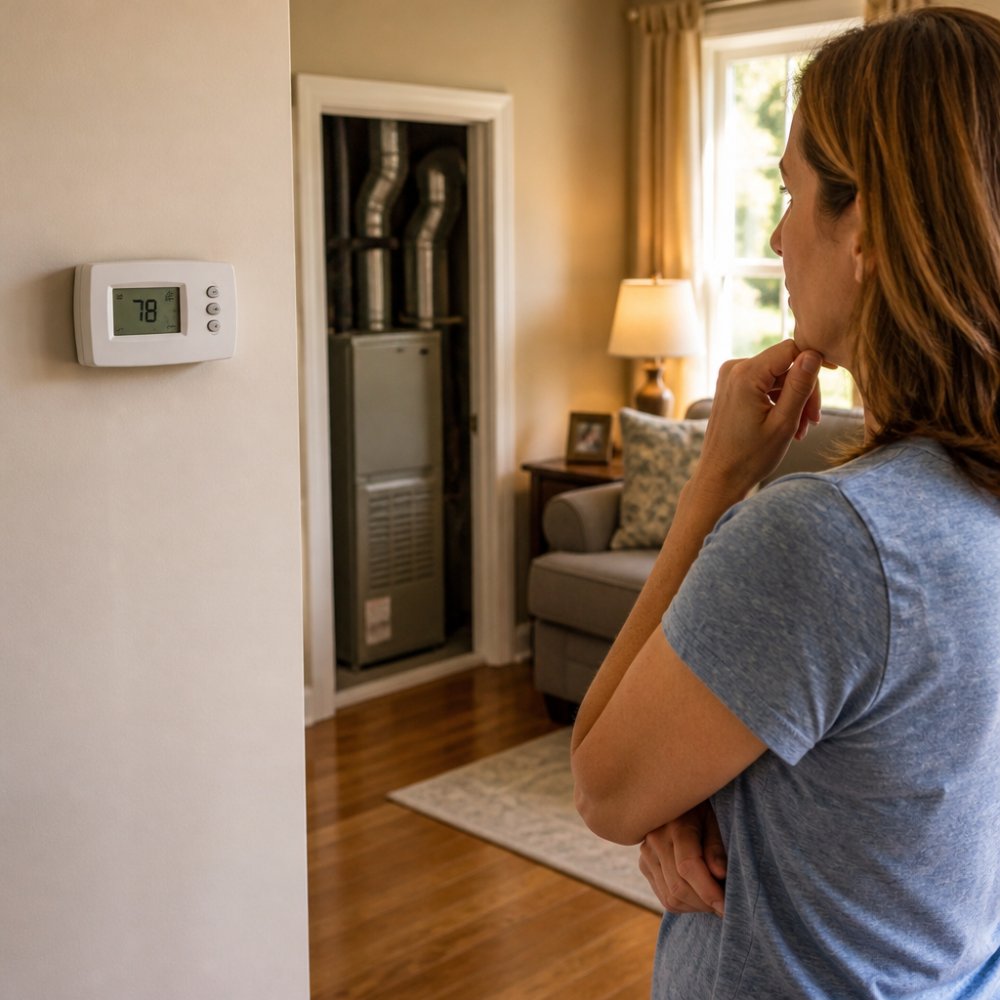
Here is the full list we walk through with homeowners:
- Frequent or increasingly costly repairs
- Rising energy bills with no change in usage
- Uneven temperatures between rooms
- Weak airflow from vents
- Persistent drafts
- Longer run times or frequent cycling
- Unusual noises during operation
- Excessive dust and worsening indoor air quality
Frequent Repairs and Rising Energy Bills
Two signs hit your wallet directly. Frequent repairs are the most reliable indicator of an aging HVAC system: when you call a technician twice in one season for different problems, the components are wearing out together, not failing in isolation.
Rising energy bills tell the same story from the utility side: as a cooling system ages, it loses efficiency and works harder to reach the same temperature.
Uneven Temperatures, Weak Airflow, and Strange Noises
Comfort problems are the signs homeowners notice first. Uneven cooling between floors, weak airflow at the vents, and persistent drafts all suggest the system can no longer distribute air the way it once did, deteriorating ductwork seals can leak conditioned air before it reaches a room.
Noises are the warning you should never ignore. Squealing or screeching often points to a failing blower motor or belt; banging and grinding suggest loose or worn internal components.
Grinding or banging noises are not normal operating sounds. Ignoring them can turn a component repair into a full system failure, and a failed compressor often costs more than the unit is worth.
Safety Warning Signs That Mean Stop and Call for Help
Most symptom lists stop at comfort and cost. These are safety signals: shut the equipment off and call a qualified technician rather than waiting for a convenient appointment.
- A gas smell near the furnace or water heater. Do not flip switches, light anything, or run appliances. Leave the building and call your gas utility’s emergency line from outside, then call a licensed HVAC technician.
- A carbon monoxide alarm sounding. Get everyone outside, call 911 or the fire department, and do not re-enter until responders clear the building. A cracked heat exchanger in an aging furnace is a common cause, and it is not a repair to defer.
- A burning or electrical odor from the equipment or vents. Shut the system off at the thermostat and the breaker, and have it inspected before running it again. This can indicate an overheating motor, failing wiring, or a blower problem.
- Repeated breaker trips when the system starts. A breaker that trips more than once is telling you the unit is drawing more current than it should. Stop resetting it and call for service; repeated trips can precede a compressor or wiring failure.
These are the signs where the repair-or-replace question waits. Safety comes first: have a technician evaluate the equipment before you spend another dollar on it.
What These Signs Have in Common
Individually, each symptom has a plausible cause that is not aging: a dirty filter, a thermostat in the wrong mode, a closed damper, a loose belt. The pattern matters more than any single item. When two or three signs appear in the same season on equipment already past the midpoint of its expected lifespan, the system is wearing out together, that is the moment to start planning rather than reacting.
Signs Your HVAC System Needs Replacement, Not Just a Repair
Your HVAC system likely needs replacement rather than repair when it is past its expected lifespan, needs repeated repairs, and no longer keeps your home comfortable.
A single repair on a ten-year-old system is normal. A third repair in two years on a system past its expected life is money you won’t get back.
Safety matters here too. An aging furnace can develop cracks in the heat exchanger, a serious concern and a reason to have the unit inspected rather than simply repaired.
How to Find Your HVAC System Age
You can find your HVAC system’s age from the data plate on the outdoor unit or furnace, which lists a manufacture date, and by checking the serial number, which many manufacturers encode with the production year.
Here’s how to check safely:
- Turn off the system at the thermostat.
- Locate the rating plate on the outdoor condenser or inside the furnace cabinet.
- Read the manufacture date printed on the plate.
- If only a serial number is listed, note it and ask a technician to decode it.
Your service records are the other half of the picture: maintenance and repair history is evidence of aging a data plate can’t show. A well-maintained system often outlasts a neglected one of the same age, so bring your records to any repair-or-replace conversation.
HVAC System Lifespan: How Long Should It Last?
Most HVAC systems last roughly 10 to 15 years for air conditioners and heat pumps and 15 to 20 years for furnaces, though maintenance history and local climate shift those ranges. Equipment that receives regular tune-ups tends to reach the upper end; neglected systems often fall short.
Reach out to us for more information… →
| Equipment Type | Typical Lifespan | What Shortens It |
|---|---|---|
| Central air conditioner | 10-15 years | Missed tune-ups, dirty coils |
| Heat pump | 10-15 years | Frequent cycling, refrigerant leaks |
| Gas furnace | 15-20 years | Clogged filters, ignored repairs |
| Ductwork | 15-20 years | Leaky seals, poor installation |
An oversized or undersized unit is another factor: a system never matched to the home’s capacity runs longer and wears faster, which is why proper sizing at installation matters as much as the brand on the box.
Repair or Replace Your HVAC System? A Decision Framework
Use this framework to decide whether to repair or replace your HVAC system: repair when the unit is under 10 years old, the fix is minor, and efficiency is still solid; replace when it’s past its lifespan, repairs are frequent, or efficiency has clearly dropped.
A single rule of thumb rarely settles the question. Weigh five factors together, because a system can fail one test and still be worth repairing, or pass every test and still be a poor investment.
Factor 1: Age Relative to Expected Lifespan
Compare the equipment’s manufacture date to the typical lifespan for its type. A 12-year-old air conditioner is near the end of its range; a 12-year-old furnace may have several good years left. Age alone is not decisive, but it sets the baseline. A major repair on equipment already past its expected life is money you are unlikely to recover.
Factor 2: Repair Cost as a Share of Replacement
Ask the technician for the repair estimate and a replacement estimate in the same conversation. A common guideline: a repair costing more than roughly half the price of a new system on already-old equipment signals replacement. The threshold is a judgment call, but the comparison is the point, a repair should buy meaningful remaining life, not just get you through the month.
Factor 3: Repair Frequency and Pattern
One repair is normal maintenance. Two repairs in two seasons on different components suggests the parts are wearing out together, and a third is likely close behind. If the same component keeps failing, or repairs spread across the blower, compressor, and controls, the system is at the end of its run.
Factor 4: Efficiency and Operating Cost
An aging unit loses efficiency gradually, so the bill creeps up without an obvious cause. Compare current seasonal bills to what you paid three or four years ago with similar weather and usage; a clearly upward trend means the equipment is working harder for the same result. Modern equipment’s efficiency ratings let you compare a replacement against your current unit, but treat any savings estimate as a projection, not a promise, actual savings depend on your home, climate, and usage.
Factor 5: Warranty Status and Future Risk
Check whether the equipment is still under a manufacturer’s parts warranty or an installer’s labor warranty. A system still under warranty changes the math: a covered repair is far cheaper and may be worth doing even on older equipment. Once coverage lapses, every repair is out of pocket and the risk of a major failure rises each year.
Putting the Factors Together
Work through these questions in order:
- How old is the system? Past expected lifespan leans toward replacement.
- How often are you repairing it? Two or more repairs in two seasons is a red flag.
- How big is the repair? A minor part favors repair; a compressor or heat exchanger favors replacement.
- Is comfort still good? Uneven temperatures and weak airflow point to replacement.
- Are bills climbing? Declining efficiency means you’re paying more for less.
Ask for the repair cost as a share of replacement. If a single repair approaches a large fraction of a new system’s cost on equipment that’s already old, replacement usually wins over the long run.
No single factor decides repair versus replacement. When age, repair frequency, rising bills, and lapsed warranty all point the same direction, replacement is the lower-risk choice. When only one factor is out of line and the rest look healthy, a repair is often the smarter spend.
Diagnostic Checks Homeowners Can Do Safely
Homeowners can safely check a few things themselves: the air filter, thermostat settings, outdoor unit clearance, and whether vents are open and unobstructed. These checks catch simple problems before they become service calls.
- Replace a clogged air filter, a common cause of weak airflow
- Confirm the thermostat is set to the right mode and schedule
- Clear leaves and debris from around the outdoor unit
- Check that supply vents are open and not blocked by furniture
- Note any new noises, smells, or cycling patterns to report
Do not open equipment panels, handle refrigerant, or attempt electrical work, those tasks belong to a licensed technician. Our technicians diagnose the problem and explain the options honestly, so you’re never pushed into a repair or replacement you don’t need.
An aging system rarely fails without warning. As a family-owned business, with the owner having over 45 yrs hvac experience, we offer honest diagnostics, reliable repair for all makes and models, and energy-efficient system installations that keep your home comfortable year-round.
Frequently Asked Questions
How long does an aging HVAC system typically last?
Most central air conditioners last 12 to 15 years, while furnaces often reach 15 to 20 years with regular maintenance. Heat pumps fall in the 10 to 15 year range. Lifespan depends heavily on service history, installation quality, and how hard the system works during peak cooling and heating demand. If your equipment is past those ranges and you are noticing frequent repairs or rising energy bills, it is time to plan for replacement rather than wait for a breakdown.
Should I repair or replace an aging HVAC system?
Weigh repair frequency, rising energy bills, and whether the unit uses outdated refrigerant. A licensed technician can confirm with a load calculation and efficiency check.
Can an aging HVAC system cause higher energy bills?
Yes. As components wear, the system loses efficiency and runs longer to reach the thermostat setting. Dirty coils, failing compressors, and leaky ductwork all push operating costs up. If your summer bills have climbed noticeably without a rate increase or change in usage, the equipment is a likely culprit. A tune-up can recover some efficiency, but a system past its expected lifespan will keep costing more each season.
How do I find the age of my HVAC system?
Check the data plate on the outdoor condenser or indoor air handler. It lists the manufacturer and a serial number; the first four digits often encode the week and year of production. You can also look up the serial number on the manufacturer’s website or call a local HVAC company with the model and serial numbers. Installation records, home inspection reports, and the original permit sticker are other reliable sources if the plate is faded.