Table of Contents
- Why Regular Furnace Tune-Ups Matter More Than You Think
- What Does a Furnace Tune-Up Include? A Step-by-Step Breakdown
- How Often to Service a Furnace for Peak Performance
- Your Annual Furnace Maintenance Checklist
- Furnace Tune-Up Cost: What You’re Paying For
- Measurable Signs Your Tune-Up Was Successful
- When a Tune-Up Is Not Enough: Repair vs. Replacement
- Conclusion: Protecting Your Home and Your Wallet
- Frequently Asked Questions
Last Updated: October 13, 2026
Why Regular Furnace Tune-Ups Matter More Than You Think
The importance of regular furnace tune-ups comes down to one uncomfortable fact: most heating systems don’t fail suddenly. They fail slowly, over one or two skipped seasons, until a cold snap exposes every neglected component at once. At 1st Service HVAC, we’ve seen what happens when tune-ups get skipped, with homeowners often saying the same thing: “It was working fine last week.”
A furnace tune-up is a scheduled service visit where a technician inspects, cleans, lubricates, and tests every component that affects how your heating system burns fuel, moves air, and vents exhaust. It’s preventive maintenance, not a repair. The distinction matters, because the value shows up in what doesn’t happen: no mid-winter breakdown, no carbon monoxide risk, no slow climb in your utility bill.
Below, we break down what a tune-up includes, how often to service a furnace, what it costs, and when maintenance stops being enough.
A furnace that runs “fine” can still be losing efficiency every month. Tune-ups catch the slow degradation that you can’t hear or feel until it becomes a repair bill.
What a Furnace Tune-Up Actually Is
A furnace tune-up is a preventive maintenance appointment that covers cleaning, inspection, lubrication, and performance testing of the entire heating system. It is not the same as a repair call, where a technician responds to a specific failure.
Think of it as two different jobs. A repair fixes what broke. A tune-up finds what’s about to break, and corrects the conditions that cause breakdowns in the first place. The U.S. Department of Energy guidance on home heating makes the same point: routine maintenance is one of the most cost-effective steps a homeowner can take to keep a heating system running efficiently.
The Real Cost of Skipping Annual Maintenance
Skipping annual maintenance rarely saves money. It defers it.
A dirty burner or clogged filter forces the system to run longer to reach the same temperature. A worn blower motor draws more current. A cracked heat exchanger, left unchecked, becomes a safety problem rather than a repair. None of these announce themselves early. They accumulate quietly through the heating season.
The homeowners who call us for emergency service in the middle of a cold snap are almost never the ones who booked a fall tune-up. That’s the pattern, and it’s consistent.
What Does a Furnace Tune-Up Include? A Step-by-Step Breakdown
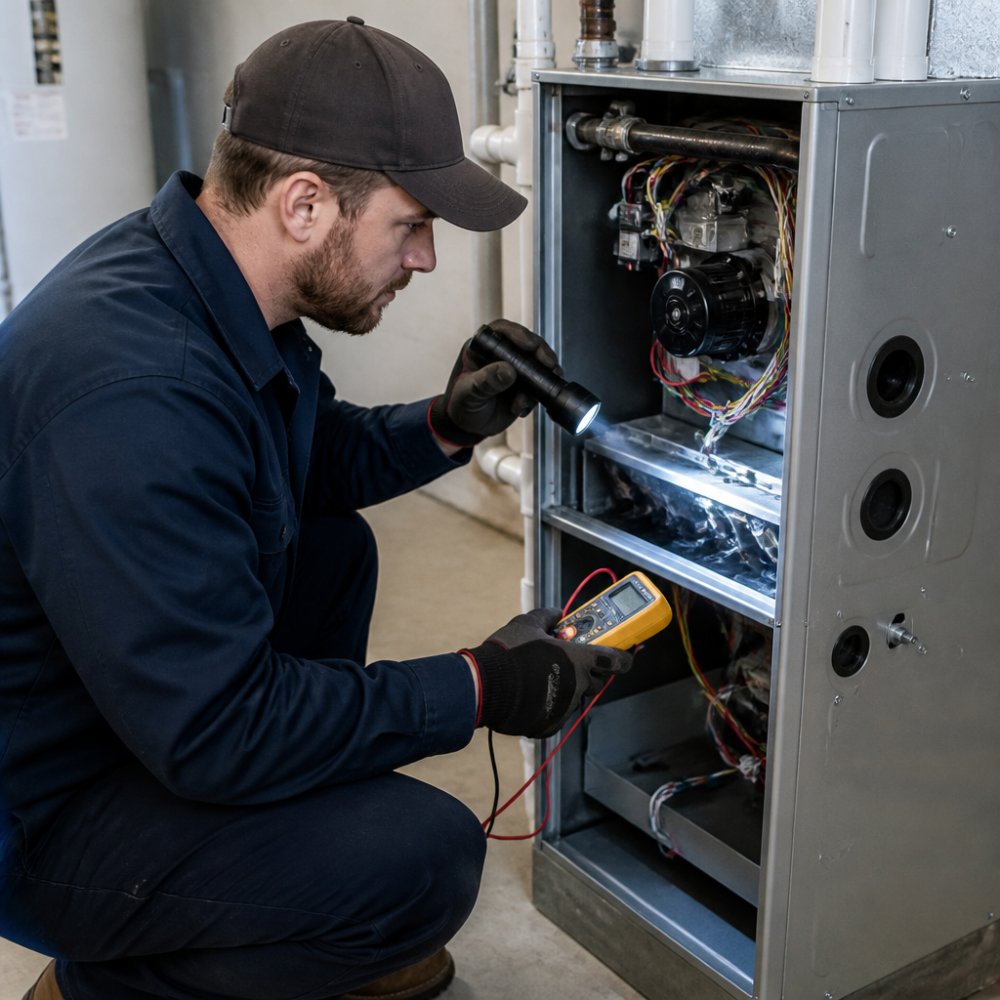
A standard furnace tune-up covers four categories of work: combustion and safety checks, mechanical inspection, electrical testing, and airflow verification. The exact checklist varies by fuel type and system age, but the sequence below reflects how we run a service call.
- Thermostat calibration and test – verify the thermostat calls for heat accurately and cycles the system correctly.
- Air filter inspection – check for restriction and replace if needed.
- Blower motor service – clean, lubricate where applicable, and check amperage draw.
- Burner inspection and cleaning – remove soot and debris, verify flame pattern.
- Ignition system check – test the igniter or pilot, and confirm reliable light-off.
- Flame sensor cleaning – a dirty sensor is one of the most common causes of short cycling.
- Heat exchanger inspection – look for cracks, corrosion, or separation.
- Gas or oil connections – check for leaks and verify pressure.
- Venting and flue inspection – confirm exhaust gases leave the home properly.
- Condensate drain clearing – on high-efficiency units, a clogged drain shuts the system down.
- Electrical connection tightening – loose connections cause voltage drop and heat.
- Combustion analysis – measure the air-to-fuel ratio and confirm safe operation.
- Temperature rise test – compare return and supply air to confirm the system heats as designed.
That’s the full scope.
Combustion and Safety Checks
Combustion testing is the part of a tune-up that protects your household, not just your equipment.
A technician measures the air-to-fuel mixture, checks the flame for proper color and shape, and confirms that exhaust is venting correctly. The heat exchanger gets a close inspection because a cracked exchanger can allow carbon monoxide into the living space. Carbon monoxide is odorless, and the CDC information on carbon monoxide poisoning notes that it sends thousands of people to emergency rooms each year. A combustion analyzer and a visual inspection of the exchanger are the two tools that catch this before it becomes dangerous.
Mechanical and Electrical Inspection
Mechanical and electrical checks address the moving and powered parts that wear out over a heating season.
The blower motor, belts, bearings, and fan are cleaned and lubricated. Electrical connections at the control board, igniter, and motors are tightened and tested. A technician measures amp draw on the blower and inducer motors, because rising amperage signals a motor that’s working harder than it should. That reading, more than any visual check, tells you whether a component is on its way out.
How Often to Service a Furnace for Peak Performance
Once a year, in the fall, before the heating season begins. That’s the short answer for nearly every home.
Manufacturers typically build their warranty terms around annual professional maintenance, and skipping it can void coverage on parts. If your system is older, has had prior repairs, or runs in a household with pets or heavy dust, an annual visit becomes even more important rather than less.
| System Situation | Recommended Frequency | Why |
|---|---|---|
| Standard gas furnace, under 10 years | Once per year | Meets warranty terms, catches wear early |
| Oil-fired furnace | Once per year, ideally pre-season | Oil burners produce more soot and need nozzle and filter attention |
| System over 15 years | Once per year, with closer inspection | Components near end of service life |
| Homes with pets or heavy dust | Once per year, filter checks monthly | Airflow restriction accelerates wear |
| Rental properties | Once per year per unit | Protects equipment and documents service history |
Fall scheduling matters because technicians book up fast once the first cold front arrives. A tune-up in October costs the same as one in December, but the December slot may not exist when you need it.
Your Annual Furnace Maintenance Checklist
Use this checklist to prepare for a professional visit and to handle the tasks that fall between service calls.
Before the technician arrives:
Reach out to us for more information… →
- Clear at least three feet of space around the furnace
- Note any unusual sounds, smells, or cycling behavior
- Locate your service records and warranty documents
- Confirm the model and serial number are accessible
What the professional covers:
- Full combustion and safety testing
- Heat exchanger inspection
- Burner, igniter, and flame sensor service
- Blower motor cleaning and lubrication
- Electrical connection tightening and testing
- Venting, flue, and condensate drain check
- Temperature rise and airflow verification
Homeowner Tasks Between Professional Visits
A few simple habits extend the value of your tune-up.
Check the air filter monthly and replace it when it looks dirty, typically every one to three months depending on the home. Keep vents and returns clear of furniture and rugs. Listen for new noises and write them down; a description of when a sound occurs helps a technician diagnose faster. If you notice a yellow, flickering burner flame instead of a steady blue one, call for service rather than waiting for the next scheduled visit.
Never ignore a yellow or orange burner flame or a smell of exhaust indoors. Both point to a combustion or venting problem, and both are reasons to shut the system down and call a technician rather than wait for your next tune-up.
Furnace Tune-Up Cost: What You’re Paying For
Pricing for a furnace tune-up depends on your system type, its condition, and whether any parts need replacing. We don’t publish flat rates because the honest answer is that a well-maintained gas furnace and a neglected oil system are not the same job.
What you’re paying for is technician time, diagnostic equipment, and the parts that get consumed during service, such as filters. A tune-up that includes combustion analysis requires a calibrated analyzer and a technician trained to read it. That’s the difference between a quick filter swap and a real inspection.
For current pricing on tune-ups and maintenance plans in the Richmond area, contact us directly and we’ll give you a straight answer based on your system.
Measurable Signs Your Tune-Up Was Successful
You shouldn’t have to take a technician’s word for it. A proper tune-up produces results you can verify.
Ask for the combustion readings and the temperature rise measurement. Compare them to the manufacturer’s spec for your model. A system running within spec will heat the home faster and cycle less often. Watch your next utility bill; a furnace that had been running rich or starved for air will show the correction there. And listen. A serviced blower motor and a clean burner run quieter than a neglected one.
If a technician can’t tell you what your readings were before and after, the visit wasn’t a tune-up. It was a look.
When a Tune-Up Is Not Enough: Repair vs. Replacement
A tune-up maintains a healthy system. It cannot fix a failing one.
Replacement starts to make more sense when the system is aging, when repairs are recurring, or when the cost of a major repair approaches a meaningful share of a new system. The ENERGY STAR guidance on heating and cooling equipment points out that older equipment often runs well below the efficiency of current models, which means the gap in operating cost widens every year you keep it.
The honest framing we give homeowners: if your furnace needs a major component replaced and it’s already near the end of its expected service life, putting money into it is a short-term fix with a known expiration date. A tune-up can’t change that math. What it can do is catch the problem early, while you still have time to plan a replacement on your schedule rather than in an emergency.
Conclusion: Protecting Your Home and Your Wallet
The homeowners who avoid emergency heating calls aren’t lucky. They book maintenance before the season starts and keep their service records in order. That’s the whole strategy, and it works because a furnace gives you warning signs long before it quits, if someone is looking for them.
At 1st Service HVAC, our team handles furnace maintenance, AC repair, and full system installations, and we’ll tell you plainly whether your system needs service, a repair, or replacement. As a family-owned business, we’d rather earn your trust with an honest assessment than sell you something you don’t need.
Get started with 1st Service HVAC and keep your home comfortable through every season.
Frequently Asked Questions
Do I really need a furnace tune-up every year?
Yes, annual service is the standard recommendation from manufacturers and HVAC professionals. A yearly furnace tune-up keeps your system running safely and efficiently. Skipping it allows dust, wear, and small faults to accumulate, which reduces energy efficiency, raises heating costs, and increases the risk of a mid-winter breakdown. Regular maintenance also helps preserve your manufacturer warranty, since many require documented annual service.
How long does a furnace tune-up take?
A standard furnace tune-up involves cleaning components, inspecting the heat exchanger and burners, testing the ignition system and flame sensor, checking electrical and gas connections, verifying airflow, and measuring performance. If the inspection uncovers a worn part or a safety concern, the visit may run longer to address it.
Can regular furnace maintenance lower my energy bills?
A well-maintained furnace holds its operating efficiency closer to its rated level. Dirty burners, restricted airflow, and a clogged air filter all force the system to run longer to reach your thermostat setting, which drives up heating costs. Keeping up with annual furnace maintenance and changing your filter regularly helps your system use less fuel for the same indoor comfort.
What is the $5,000 rule for HVAC systems?
The $5,000 rule is a common guideline: if the cost of a repair multiplied by the age of your system exceeds $5,000, replacement is usually the better financial choice. For example, a $600 repair on a 10-year-old furnace equals $6,000, which points toward replacement. It is a starting point for the repair versus replacement decision, not a hard rule.